SiC portfolio pushes reliability and efficiency benchmarks for solid-state transformers, utility-scale storage, renewable infrastructure and megawatt-class fast-charging, backed by advanced packaging and extended qualification.
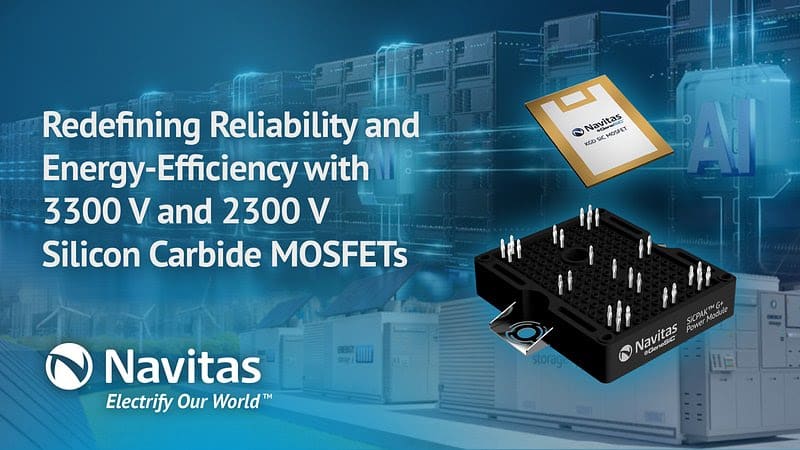
Navitas has introduced a new line of 3300V and 2300V ultra-high-voltage (UHV) silicon carbide (SiC) devices aimed at mission-critical energy systems, targeting sectors such as AI data-center power delivery, utility-scale storage, renewables, industrial electrification and megawatt-class EV fast-charging. The new parts, available as power modules, discrete devices and known-good dies (KGDs), extend the company’s SiC roadmap toward future 10 kV platforms while pushing reliability metrics beyond existing industry norms.
At the center of the portfolio is the company’s latest GeneSiC platform built on a Trench-Assisted Planar (TAP) MOSFET architecture. The design uses a multi-step electric-field management structure that reduces voltage stress and strengthens voltage-blocking capability compared with conventional trench and planar SiC devices. The approach is engineered to enhance long-term robustness, avalanche performance and switching efficiency at high temperatures, key requirements for high-power converters in harsh electrical environments.
The key features are:
- Based on the latest Trench-Assisted Planar (TAP) architecture for higher voltage-blocking strength.
- Lower hot-temperature RDS(on)
- Improved switching FoM enabled by optimized source contact and enhanced current spreading.
- SiCPAK G+ modules with epoxy-resin potting offer >60% longer power-cycling life and >10× thermal-shock reliability.
- AlN DBC substrates + high-current press-fit pins
- AEC-Plus reliability
To support these electrical gains, the company is pairing the UHV devices with packaging options designed for harsher thermal and mechanical cycles. The SiCPAK G+ power-module format, available in half-bridge and full-bridge topologies, incorporates epoxy-resin potting said to extend power-cycling lifetime by more than 60% and deliver a tenfold boost in thermal-shock reliability over silicone-gel alternatives. Additional design elements such as AlN DBC substrates for heat spreading and new press-fit pins with doubled current-carrying capability target compact, high-density systems.
A significant part of the announcement focuses on reliability validation. The company has created what it calls an “AEC-Plus” benchmark, reflecting qualification beyond AEC-Q101 and JEDEC requirements. The extended regimen includes dynamic reverse-bias and dynamic gate-switching tests, tripled durations for high-temperature bias stress, HV-THB/H3TRB tests for modules and discrete parts, and longer thermal and power-cycling sequences aligning the devices with the mission profiles of grid-class power systems.
For customers building their own modules, the lineup is also available as known-good die. Each die undergoes room- and hot-temperature testing after singulation, followed by six-side optical inspection aimed at screening latent defects before assembly. The intent is to lift manufacturing yield and guarantee consistency in custom UHV module builds.