

A new family of SiC MOSFETs delivers higher thermal performance, increased voltage headroom, and a significantly slimmer footprint aimed at AI servers, PV inverters, ESS units, and next-generation high-density power supplies.
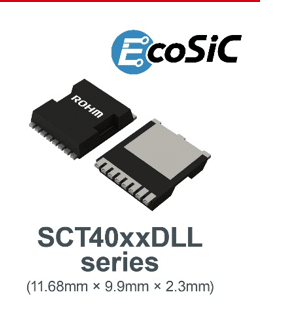
As data-center power architectures, AI servers, and compact renewable-energy systems race toward higher power levels, designers are pressed to shrink form factors without compromising thermal reliability. A new line of silicon-carbide MOSFETs by ROHM Semiconductor in a TO-Leadless (TOLL) package aims directly at this tension, delivering a significant boost in power density while cutting device height nearly in half. The devices arrive as the demand for ultra-slim, high-efficiency power stages especially in totem-pole PFC designs reaches a critical point for next-generation hardware.
The key features include:
- ~39% improved thermal performance vs. conventional TO-263-7L packages
- 750 V drain-source rating for higher surge margin (vs. typical 650 V TOLL devices)
- 2.3 mm ultra-low profile, nearly half the height of standard equivalents
- ~26% smaller footprint for high-density power stages
- On-resistance range: 13 mΩ to 65 mΩ across six device variants
The standout upgrade is the thermal leap: the TOLL-packaged MOSFETs provide roughly 39% better heat dissipation compared to legacy TO-263-7L formats with similar voltage and RDS(on) class. That improvement supports higher current handling in tighter layouts, helping engineers meet aggressive thermal budgets in 1U, “pizza-box” server supplies, slim PV inverters, and energy-storage systems where component height is tightly capped around 4 mm.
The design shift is also about footprint and voltage flexibility. The new package trims board area by around 26% and achieves a 2.3 mm profile, enabling denser PCB stacking and lower-profile mechanical designs. While most conventional TOLL MOSFETs top out at 650 V, this family pushes the ceiling to 750 V, giving designers extra surge margin and allowing the use of lower gate resistance values to reduce switching losses. This is especially relevant for high-frequency PFC stages where SiC’s fast-switching nature directly translates to smaller magnetics and higher efficiency.

The lineup includes six variants spanning 13 mΩ to 65 mΩ, targeting applications from AI-server PSUs and data-center converters to residential PV inverters and general consumer power supplies. With mass production underway and simulation models already available, the devices are positioned for rapid adoption in systems seeking both miniaturization and higher output power.
Beyond individual components, the launch strengthens the broader transition toward SiC-based architectures. As power-electronics designers chase higher efficiency, elevated switching frequencies, and reduced cooling overhead, SiC MOSFETs packaged for maximum thermal and spatial efficiency are becoming foundational elements across industrial and consumer applications.