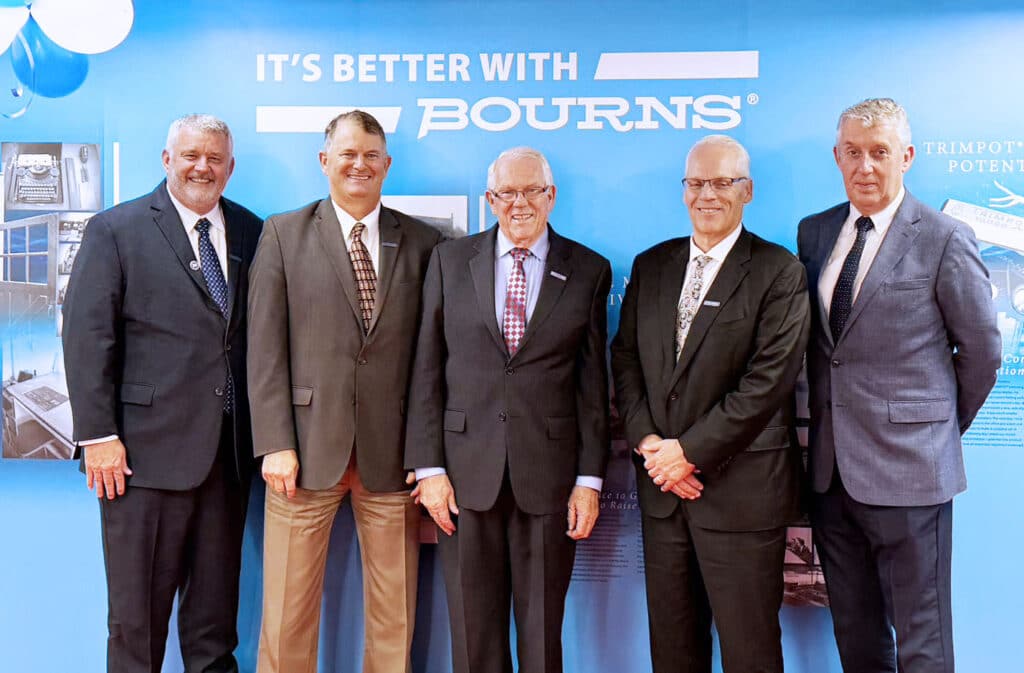
Bourns, a global electronics components manufacturer, has inaugurated a world-class design center in Bengaluru. EFY sat down with Chairman & CEO Gordon Bourns, President & COO Al Yost, Worldwide Sales Sr. VP James Harrington, and Division Presidents Craig Shipley and John Kelly to discuss their India strategy, global innovation roadmap, and expectations from India’s engineering talent.
Q. During Apollo 11, Bourns components played a vital role in the lunar module landing controls and astronaut life-support systems. What does that legacy mean today, especially with this new India Design Center launch?
Gordon Bourns: My parents Marlan and Rosemary Bourns, started Bourns Incorporated, then called Bourns Laboratories in their small garage in Pasadena, California. In the early days, what was remarkable was that they were testing sensors in a household oven and freezer before presenting them to aerospace companies. One engineer asked my father to produce a Bourdon-tube pressure transducer. While he didn’t know what that was at first, he committed to learning and building it. That product later controlled the oxygen and suit pressure for astronauts walking on the Moon.

The joysticks used to land the Lunar Module also used our devices. When the Apollo landing succeeded, my parents felt proud that a garage startup had supported one of the most important engineering feats in human history. That pioneering mindset still drives us today, from aerospace to the automotive industry, which is the largest market we support.
Q. With India accelerating its deep-space ambitions, do you see a symbolic connection here?
Gordon Bourns: Absolutely. Our leadership in automotive sensing brings credibility to delivering solutions for aerospace and defense. India’s growing presence in space aligns perfectly with Bourns’ heritage and goals for collaboration in advanced systems engineering.
Q. What is the strategic significance of the Bengaluru Design Center within Bourns’ global operations?
Al Yost: At Bourns, we have held a long-standing commitment to give our customers the technologies they need to innovate everywhere they design and manufacture their products. Our new Design Center in Bengaluru, India, represents a major step in that direction in that it strengthens our global design ecosystem by adding world-class engineering talent and expands our ability to collaborate closely with customers in one of the most dynamic technology markets in the world.
A major focus of this center is to help accelerate new product development by providing localized design and application support. One important way we accomplish this is with proven reference designs that integrate Bourns’ advanced power, protection, and sensing solutions. Our work in India is made stronger by the support the Company provides with our existing design centers in North America, Europe, and Asia, which all operate as a seamless extension of Bourns’ global engineering network.
By providing Bourns’ global design expertise closer to our customers, we help them succeed by shortening development cycles through enhanced design collaboration that enables them to deliver even more innovative, high-quality solutions. India’s talent depth, combined with our long-term commitment to investing in design excellence, makes this the ideal time and place to expand.
Q. Do you see this as an extension of your global R&D strength, or also as a center with its own specialized focus areas?
Al Yost: We absolutely see the India Design Center as both — an extension of our global R&D strength and a center with its own specialized focus areas.
From day one, it will operate as part of Bourns’ unified global engineering network, sharing tools, processes, and best practices across all our regional teams worldwide. With the engineering talent we will have in India, this design center also has a clear mandate to develop breakthrough power conversion, circuit protection, and magnetics solutions that are increasingly critical to high-growth market applications such as data centers, automotive electrification, and industrial automation.
Our approach is to build depth, not just capacity. This means investing in domain experts, developing local partnerships with universities and customers, and making it a priority for the center to pioneer design methodologies that can later be replicated across our other facilities worldwide. So, while it reinforces Bourns’ R&D strength globally, it also means we can add a distinctive layer of innovation and agility that comes from India’s remarkable engineering ecosystem.
Q. Any measurable contributions that you’re expecting from the Indian engineering talent in developing IP and products targeted for the global market, not just local demand?
Al Yost: Absolutely! Our intent from the outset is for the India Design Center to be a key contributor to Bourns’ global innovation pipeline, not a regional satellite. We’re building this center with clear performance goals around intellectual property creation, new product development, and time-to-market acceleration.
In tangible terms, we expect the India team to contribute directly to patent filings, design platforms, and reference architectures that serve worldwide customers — from automotive and industrial applications to energy infrastructure and data centers.
We are already aligning the India engineering roadmap with our global R&D strategy so that the projects here directly feed into Bourns’ next generation of power, protection, and sensing solutions.
We also see this center as a driving force to increase measurable efficiencies that shorten design cycles, improve cross-regional collaboration, and enable faster prototypes. Over time, we expect a meaningful percentage of Bourns’ new design IP to have contributions from India. This speaks volumes to both the quality of the engineering talent and to our belief that technology advancements today must be borderless.
Q. Now that we understand the big picture, could you share your expectations on which market segments your team expects to see the most rapid adoption and growth across India’s electronics market?
James Harrington: India’s electronics market is undergoing a tremendous transformation, and we’re seeing momentum in several high-growth segments that align very closely with Bourns’ strengths.
The most immediate opportunities are in automotive electrification, industrial automation, and data centre infrastructure. Prime examples are that electric vehicles and EV charging networks are driving strong demand for our power conversion and circuit protection solutions.
In parallel, India’s expanding manufacturing base and automation push are fueling adoption of our sensing and control components.
And as hyperscale data centers and 5G networks proliferate, there’s a clear need for the reliability and performance Bourns provides in surge protection, magnetics, and resistive technologies.
What’s equally exciting is how the India Design Center will help us localize support and collaborate more deeply with OEMs, design houses, and contract manufacturers here. That proximity allows us to shorten design cycles, co-create solutions, and facilitates the transformation of global technologies into platforms optimized for regional requirements.
Therefore, while these segments will lead near-term growth in India, the long-term story is about how the country is becoming a design and manufacturing hub that serves global markets — and Bourns is positioning itself to be a strategic partner in that journey.
Q. How does this design center help Bourns’ deliver faster, more application-specific solutions for Indian OEMs; and more efficient support for global customers?
James Harrington: That’s really at the heart of why we established this center. Our customers today expect more than just high-quality components; they want partners who understand their application challenges and can respond quickly with customized solutions. The India Design Center allows Bourns to do exactly that.
For Indian OEMs, it means we can now engage with their design teams in real time to co-developing circuits, validate prototypes faster, and further optimize designs to meet local performance, cost, and compliance requirements. This kind of proximity helps our customers to dramatically reduce the time from concept to production.
For our global customers, the benefit is just as powerful. The center enhances our ability to run projects around the clock, leveraging time-zone diversity, and capitalize on meaningful engineering collaboration across continents. It allows us to provide faster response cycles, rapid design iterations, and specialized support for emerging technologies — from EVs and renewable energy systems to industrial power supplies and communications infrastructure.
In short, the India Design Center is not just expanding capacity, it strengthens customer trust, encourages rapid development at the speed of market expectations, and boosts our ability to deliver application-specific breakthroughs that drive measurable business value for our customers and partners worldwide.
Q. Any specific protection or sensing technology trends that are critical for the evolving Indian market such as in EVs, industrial or telecom?
Craig Shipley: India is entering a pivotal phase in its technological growth, and from a protection and sensing standpoint, several key trends are shaping how Bourns plans to support our customers’ innovation.
In electric vehicles and charging infrastructure, we’re seeing a growing emphasis on high-energy transient protection and thermal management. As powertrain voltages increase and fast-charging becomes standard, the need for hybrid surge protection devices like Bourns® IsoMOV® protectors becomes essential. Providing revolutionary surge protection performance, IsoMOV® hybrid protectors offer compact, reliable, and long-life solutions that safeguard sensitive electronics from repetitive surges.
In the industrial automation sector, we’re witnessing a major push toward the adoption of connected factories and intelligent controls. These next-generation applications are driving demand for multi-level protection architectures that are able to combine overvoltage, ESD, and current limiting capabilities into single solutions to help ensure system uptime in harsh electrical environments.
For telecom and data infrastructure designs, India’s 5G rollout is creating a vast network of small cells and base stations that require ultra-fast, low-capacitance protection to maintain signal integrity and reliability.
Our India Design Center allows us to localize and tailor these protection technologies — not just to meet specifications, but to optimize them for real-world Indian conditions such as voltage instability, heat, and transient-rich power grids. Our goal is to design with the environment in mind and build protection solutions that extend the lifetime and maximize the performance of every system our customers deploy.
Watch the full Interview
Q. Could you share any interesting examples of potential localized solutions addressing India’s regional design and environmental challenges?
John Kelly: Absolutely. One of the exciting aspects of establishing the India Design Center is that it gives us the ability to engineer protection solutions that are directly informed by regional realities. There are a few early concepts that already stand out.
For instance, India’s power-distribution environment is highly dynamic, with frequent voltage fluctuations, lightning events, and unstable grid transitions. Our teams are developing localized surge-protection modules that combine high-energy MOVs with gas discharge tube (GDT) devices and resettable fuse technology. This powerful combination is being optimized specifically for India’s climatic and electrical conditions.
Bourns has extensive experience in engineering hybrid assemblies. That means we can provide protection solutions that deliver greater endurance in hot, humid environments while maintaining compact form factors for EV chargers and smart meters.
We’re also collaborating with local OEMs and design houses to develop next-generation AI infrastructure protection arrays that can be easily scaled for power-hungry systems.
Our goal is to give design engineers plug-and-play flexibility while ensuring compliance with evolving safety and EMI standards. What’s most rewarding and meaningful to our customers is that these are not one-off adaptations. These designs represent useful and forward-looking innovations that can be exported globally, reinforcing Bourns’ philosophy that local challenges often inspire world-class solutions.
Q. As Bourns begins this exciting chapter in India, what is Bourns’ long-term vision for the Indian engineering ecosystem?
Al Yost: Bourns’ long-term vision for the Indian engineering ecosystem goes far beyond building a design center. It’s about building a sustained partnership with the expanding group of advanced technology developers here. We can help make them more competitive by leveraging India’s incredible talent base and integrating that strength into the core of Bourns’ global innovation network.
We see India not just as a cost-efficient location, but as a center of design excellence that will take ownership of complete product platforms, from concept and simulation to validation and global release. Over time, the India Design Center will evolve from supporting global projects to leading them, driving both intellectual property creation and next-generation product architectures for Bourns’ Power, Protection, and Sensing Divisions.
Another key pillar of our vision is with collaboration and capability development. We plan to work closely with local universities, research institutions, and customers to create a continuous talent pipeline, one that blends Bourns’ deep engineering heritage with India’s innovation-driven mindset.
Ultimately, we want our Indian operations to be recognized as a global engineering hub. As we continue to build a world-class team that not only delivers technical excellence, we expect them to influence state-of-the-art product features that enable even safer, smarter, and more sustainable systems.
Our design center opening is the beginning of a long-term investment in people, ideas, and partnerships, which also reflects our confidence in India’s role as a vital contributor to the future of Bourns.
Q. How does Bourns plan to cultivate partnerships with universities or R&D programs (e.g., ISRO, DRDO, IITs) help to build itself as an indispensable strategic partner in India?
Al Yost: That’s an area we’re very excited about. For Bourns, the India Design Center isn’t just a facility, we see it as the foundation for a collaborative ecosystem that connects industry, academia, and research institutions to drive innovation at scale.
We plan to cultivate strategic partnerships with leading universities such as the IITs and IISc, as well as with applied research organizations like ISRO and DRDO, to jointly explore new technologies in areas like power conversion, energy storage, circuit protection, and sensor integration. These are domains where India’s research depth and Bourns’ product development leadership can intersect to create truly impactful solutions.
In addition, our approach will include internship programs, sponsored research projects, and advanced training initiatives that give engineering students and researchers hands-on exposure to real-world product development. We want the next generation of engineers to see Bourns not just as a global company operating in India, but as a knowledgeable partner that helps shape the country’s design and manufacturing ecosystem.
Over time, we envision creating joint innovation labs and centers of excellence where our engineers and academic researchers can co-develop proof-of-concept technologies, accelerating the transition from idea to market-ready design. By building these connections and collaborative environments, we will meet our goal of becoming an indispensable strategic partner.
In doing so, we contribute both to India’s engineering growth, and also to the greater advancement of global technologies that make systems more efficient, reliable, and sustainable.
Q. Any message to Indian engineering professionals aspiring to work with Bourns in India?
Gordon Bourns: My message to Indian engineering professionals is simple: This is your moment. Bourns is building something truly special in India where you can be a positive contributor in a design center where innovation, collaboration, and purpose come together to shape technologies that impact millions of lives around the world.
We are looking for engineers who are not only technically knowledgeable, but also curious, creative, and customer-focused. We want people who are passionate about designing solutions that make systems safer, smarter, and more efficient. Whether your expertise is in power electronics, protection technologies, or magnetics or sensing components, there is a place for you at Bourns to grow, contribute, and lead.
What sets Bourns apart is our culture that emphasizes values of integrity, teamwork, customer support excellence and delivering the highest quality products. You’ll be working side by side with global teams across the U.S., Europe, and Asia, contributing to designs that go into everything from electric vehicles to next-generation data centers. And you’ll be doing it in an environment that trusts engineers to lead innovation, not just execute it.
In appealing to India’s bright engineering minds, if you have a driving ambition to solve real-world challenges and want to be part of a company with a 75-year legacy of innovation and a forward-looking global vision, then we encourage you to come to Bourns to make a positive difference.
EFY: Thank you for answering all our questions, and congratulations once again to the Bourns team on this key investment in India’s electronics future. We look forward to tracking the innovations that will emerge from this center, and the engineers who will build them.