

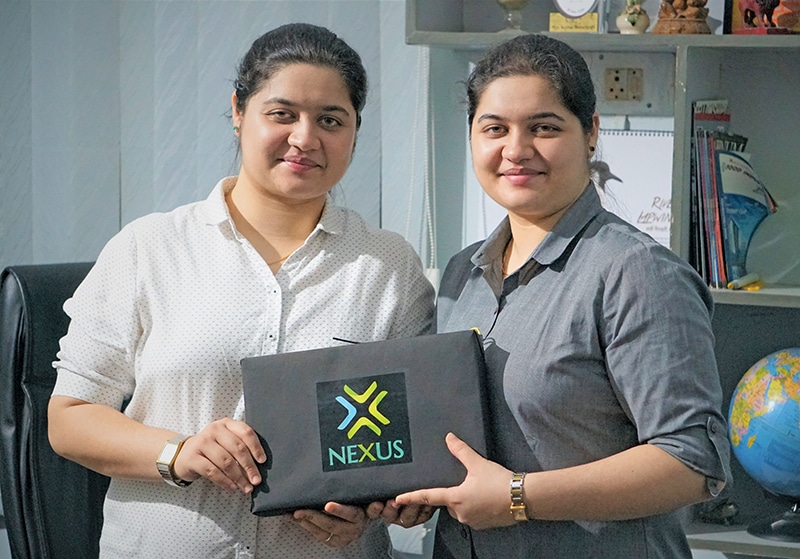
Twin sisters identified two converging challenges—rising pollution and the high cost of EV batteries—and responded by converting discarded crop waste into a safe, rechargeable battery chemistry. Could this mark a new direction for clean energy?
Nishita and Nikita Baliarsingh first discussed taking environmental action during a conversation on their terrace. Their research into electric vehicles (EVs) revealed batteries that were costly, reliant on scarce materials, and raised safety concerns. At the same time, pollution levels in North India were rising due to widespread crop-residue burning. This led to a simple but disruptive question: could agricultural waste be repurposed as battery material?
“During the 2020 lockdown, we ran a small at-home experiment using crop residue. To our surprise, it worked, producing nearly 5 volts. That result shaped our direction and led us to focus on building safe, clean batteries from natural biomaterials. We named the company Nexus to reflect connection, linking ideas, challenges, and battery cells into a single solution,” Nikita says.
Check the full conversation with Nexus Power’s founders.
The batteries are rechargeable and designed as direct replacements for lithium batteries. In principle, the technology could serve any application that relies on rechargeable batteries. For now, the primary focus remains EVs—including two-wheelers, three-wheelers, and four-wheel golf carts—as well as stationary applications such as battery energy storage systems (BESS). The company operates purely as a B2B business. “Our buyers include OEMs and companies developing energy storage facilities for solar and wind projects,” Nikita adds.

The core innovation lies in the battery manufacturing process. The batteries are produced entirely from bio-based nutrients and synthesised in-house, eliminating reliance on imported materials. In terms of performance, they are on par with lithium iron phosphate (LFP) cells in energy density, charge cycles, voltage, and capacity. Although lithium nickel manganese cobalt oxide cells offer marginally higher performance metrics as a mature chemistry, these batteries remain safe, cost-effective, and competitive with LFP cells.
The journey involved several technical and operational challenges. One of the earliest and most critical hurdles was identifying suitable biomaterials. Although multiple candidate materials were evaluated, many failed to meet efficiency requirements. Technologically, the company has progressed significantly through sustained experimentation and analysis.
The startup operates a pilot manufacturing line in Bhubaneswar, which also serves as its headquarters. All current manufacturing is conducted on this pilot line. The process begins with material synthesis, followed by cell layering. The company plans to scale up this facility in the next three to four months. To accelerate development and increase capacity, the team also rents specialised equipment and laboratory space across the country, as pilot lines offer limited throughput. However, most production still comes from its own manufacturing line.
Speaking about revenue, Nikita disclosed, “Our batteries are currently in trial, testing, and pilot stages, and are not yet commercially sold. We do have some marginal pilot revenues, but to begin full commercial sales, the necessary certifications must be completed. At this stage, operations remain focused on pilots and trials rather than full-scale commercial sales.”
The company began with grants from the government of India and the government of Odisha. Its first round of funding came through programmes from Startup Odisha and multiple departments of the government of India, including MeitY, DBT, and BIRAC. An equity round followed in 2022, with subsequent rounds thereafter. “We continue to receive significant government support, with a few PSUs involved in tests and trials, along with direct collaboration with government departments in Odisha for various projects,” Nikita said.
In the short term, the company plans to expand pilot manufacturing capacity by acquiring larger production lines and collaborating with institutes that already operate manufacturing facilities. Recruitment will also be a key focus, as expansion will require additional team members. Over the long term, the startup aims to evolve into a broad-based energy innovation company, extending its impact beyond batteries into adjacent segments where it can contribute meaningfully.