Learn how researchers combine quantum dots and meta surfaces on CMOS to make smaller SWIR sensors with flexible spectral adjustments for various applications.
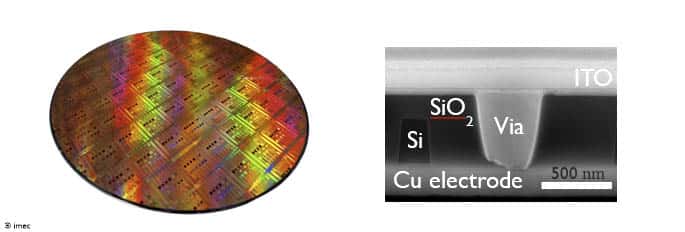
Shortwave infrared (SWIR) imaging can reveal details invisible to the human eye, including features obscured by haze, smoke, plastics or fabrics. However, conventional SWIR sensors are often bulky, expensive and difficult to scale, limiting their use in areas such as security, agriculture, automotive and aerospace. Quantum dot photodiodes (QDPDs) offer a promising solution, providing higher resolution and lower cost, but tuning their spectral response previously required complex redesigns of the photodiode layers.
Researchers at Imec have overcome this challenge by integrating colloidal QDPDs with metasurfaces on a CMOS-compatible 300 mm platform. Quantum dots are nanoscale semiconductors that absorb light at specific wavelengths, while metasurfaces are nanostructured layers that control how light interacts with the sensor. By moving the spectral tuning from the photodiode layers to the metasurface design, the team created a scalable, miniaturized SWIR sensor platform that delivers high-resolution, multispectral imaging without modifying the underlying photodiode stack.
This approach enables compact, customizable SWIR sensors that can be deployed widely while remaining compatible with standard CMOS manufacturing processes. The platform allows easy spectral adjustment for different applications, providing flexibility without the need for time-consuming redesigns of the photodiodes.
Key features of the research include:
- Integration of colloidal quantum dot photodiodes on CMOS metasurfaces
- Miniaturized, scalable, high-resolution SWIR sensors
- Spectral tuning achieved via metasurfaces rather than photodiode redesign
- CMOS-compatible fabrication enabling cost-effective production
- Potential applications across security, agriculture, automotive and aerospace
Vladimir Pejovic, R&D project lead at Imec, says, “Our approach shifts spectral tuning to the CMOS level, opening the door to easily customizable, high-resolution spectral SWIR sensors.” The breakthrough is set to evolve into an industry-ready platform through collaboration, advancing next-generation SWIR sensors from proof-of-concept to full-scale manufacturing.