New corrugated panel architecture dramatically extends OLED lifespan and increases light output efficiency, addressing key challenges in scaling OLED technology for lighting and display applications.
1 / 1
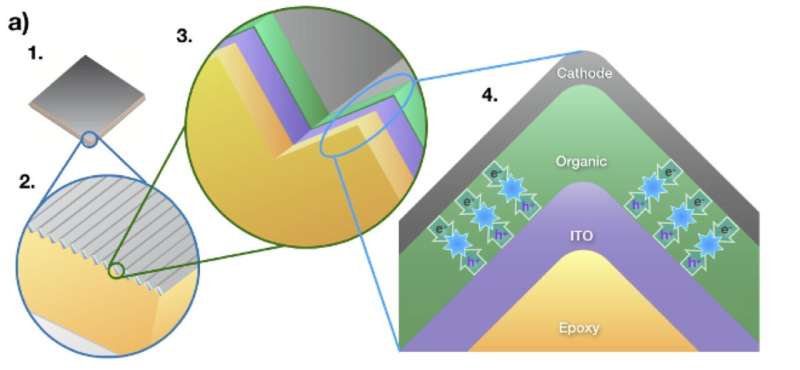
OLEDs layered on a corrugated surface last 2.7 times as long as conventional devices, according to a new study published in Nature Communications. The graphic shows the high aspect ratio OLED device from the panel level (1) to the nanoscale (4). Credit: Wang et al., 2025.
Researchers at , University of Michigan College of Engineering have demonstrated that corrugated surface designs significantly enhance organic light-emitting diode (OLED) performance, achieving both longer device lifetimes and higher light extraction efficiency, a notable advance toward more durable and efficient OLED lighting and display technologies.
Traditional OLED panels struggle when pushed to high brightness levels, especially for room-lighting applications, because organic materials degrade more quickly under intense current. The new approach rethinks the panel structure by introducing microscale corrugation ridges patterned into the panel substrate which increase the effective emitting surface area without increasing the footprint.
In recent tests, OLEDs manufactured on corrugated surfaces exhibited lifetimes 2.7 times longer than equivalent flat panels when operated at the same current. This longevity boost arises because the textured geometry reduces the local current density passing through each OLED unit, slowing degradation mechanisms particularly pronounced in blue emitters.
Beyond durability, the corrugated design also improves optical performance. By altering how light interacts with the panel structure, researchers observed roughly 40 % higher external light extraction efficiency, meaning more of the generated light escapes the device rather than being trapped internally. Computational analysis suggests that enhanced out-coupling stems from the corrugated facets facilitating light escape paths that planar layers typically do not provide.
The work was led by the University of Michigan in collaboration with OLEDWorks and The Pennsylvania State University, and detailed findings were published in Nature Communications. While the prototype primarily focused on blue and green OLEDs, the team is exploring extending the approach to white OLEDs by stacking multiple organic emitter layers, which is crucial for general lighting and full-color displays. This corrugated panel strategy represents a practical route to addressing two major OLED challenges: efficiency and operational stability, offering a compelling design alternative that could accelerate adoption in both flexible displays and solid-state lighting markets.