


If generative AI is the management consultant, agentic AI is the manager who rolls up its sleeves and gets the work done. But what will be its impact as people continue to adopt these advancements? This question framed a lively panel discussion in the session ‘Autonomous Agents: What’s Ready, Who’s Ready, and Are You Ready?’ at EFY’s AI DevCon India, 2025.
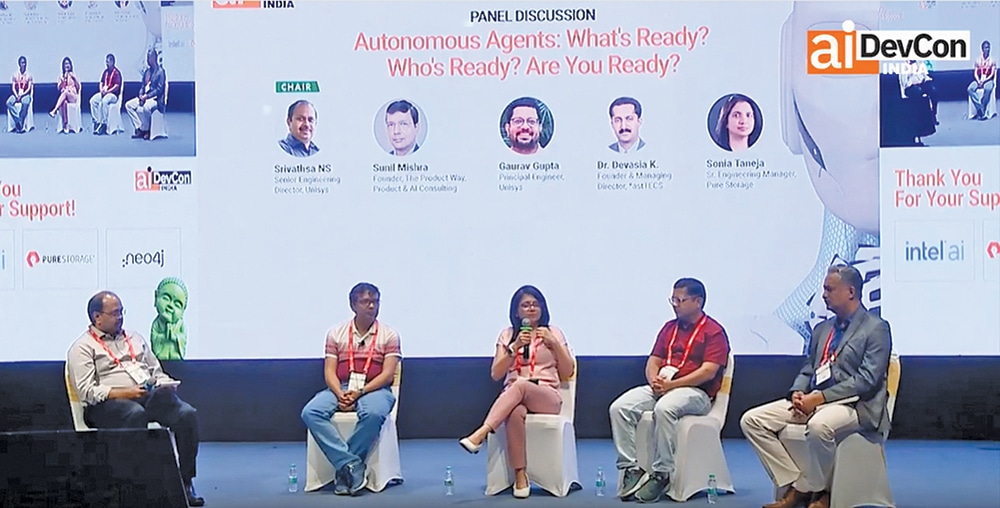
Prompt engineering was once considered the most coveted AI skill. Today, agents are creating their own prompts, highlighting the rapid evolution of AI. This transformation provides an opportunity to demystify autonomous agents and the technologies that power them.

Setting the context, Sunil Mishra, author and curator of The Product Way, a platform focused on digital product management, explains the concept through a simple analogy. “When compiling C code, I would get errors like ‘problem at line 13’ or ‘missing parenthesis’. I used to wonder, if the compiler was so intelligent, why it could not fix the issue itself. That is where agent AI comes in. It sits between advising and acting.”
Mishra outlines a fundamental distinction between generative AI and agent AI. “Generative AI is like a management consultant. It offers advice but does not implement it. Agent AI not only advises but also acts on your behalf, doing the execution work. That is what makes it powerful.”
What sets agent AI apart is its ability to reason by iteratively edit, plan, and execute tasks to optimise outcomes. It can utilise tools, connect to external systems, and operate in multi-agent environments, coordinating like a factory with specialists and managers handling escalation. Unlike generative AI, agent AI retains both short- and long-term memory, allowing it to optimise goals and continuously improve. “Combine these capabilities,” Mishra says, “and agent AI becomes a category of its own. 2025 represents a significant inflection point beyond ChatGPT.”
For organisations yet to adopt agents, what truly defines autonomy? Gaurav Gupta, Principal Engineer and AI specialist at Unisys, offers a practical comparison. “Think of AI as a car engine. That is deep learning. Put it into a car and you have generative AI; it drives, but only when instructed. Now consider a self-driving car. It plans, acts, reacts, reflects, and adapts. That is autonomous AI. The last two—reflecting and adapting—are what make it an autonomous agent.”
The panel agrees that this shift was not the result of a single breakthrough, but of steady evolution. Advances include expanded context windows in large language models (LLMs), improved memory management to retrieve past prompts, function calling for external data access, and multi-agent frameworks that function like coordinated teams of specialists.
Prompt engineering itself illustrates this transition. The efficiency of agents has overtaken prompt engineering as the most sought-after capability. But it is more of an evolution than a mere replacement. Clear instructions still matter, notes Sunil.
Sonia Taneja, Senior Engineering Manager at Nutanix, highlights the tangible impact of autonomous agents across industries. She cites autonomous vehicles that make on-the-fly decisions, even in Bengaluru traffic! In manufacturing, chip design cycles that once took years can now be completed in weeks. In financial operations, organisations such as JP Morgan have reported agents saving hundreds of thousands of human work hours annually. Healthcare applications are also advancing, with radiology systems automatically retrieving prior records, analysing scans, and flagging anomalies that clinicians might miss.
Most users today interact with AI through text-based interfaces. But what happens when agents meet voice?