Living robots now have nervous systems, letting them control movement and change behavior, pointing to a future where biology becomes programmable.
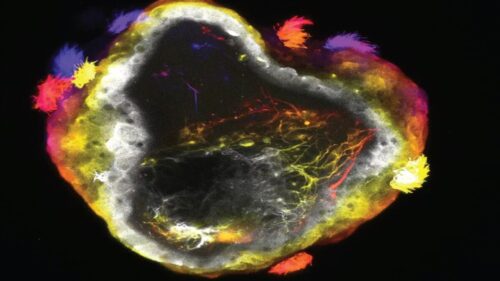
Scientists at the Wyss Institute for Biologically Inspired Engineering have created tiny living robots with functional nervous systems that can actively control their movement and behavior, moving beyond earlier biohybrid machines that lacked internal coordination.
In experiments, these constructs—called neurobots—showed clear differences from earlier biobots. They became more elongated in shape, displayed higher levels of activity, and produced more complex and varied movement patterns. When both neurobots and earlier biobots were exposed to a drug that alters neural signaling, their responses diverged. This result supports the conclusion that the newly introduced nervous systems were not passive, but were directly influencing how the robots behave.
The neurobots are built entirely from frog embryonic cells. Unlike traditional robots made from metal and silicon, or earlier living robots that relied on simple propulsion using cilia, these new systems integrate neurons within their bodies. These neurons self-organize into active neural networks and connect with other cell types, including multiciliated cells responsible for movement. This integration creates a basic internal control system.
Earlier living robots, known as xenobots, could move through liquid environments and respond to simple environmental cues, but they did not have any centralized system to coordinate activity. To address this limitation, the researchers introduced neural precursor cells at an early stage of development. Over time, these cells matured into neurons, formed connections with each other, and extended toward cells involved in motion.
The addition of nervous tissue also led to broader biological changes. Researchers observed shifts in global gene expression, including the activation of genes associated with visual system development in frogs. While this does not mean the neurobots can sense their environment, it suggests the potential for incorporating sensory capabilities in future versions.
The work builds on earlier research into cell-based machines and opens new directions for studying how living systems organize, communicate, and function. According to Donald Ingber, founding director of the institute, such systems could contribute to biomedical research by offering new ways to study development, behavior, and disease, and may eventually support applications that are not yet fully defined.