




A small shift in how metal atoms are arranged can change how electricity moves through them, pointing to new ways to build faster technologies.
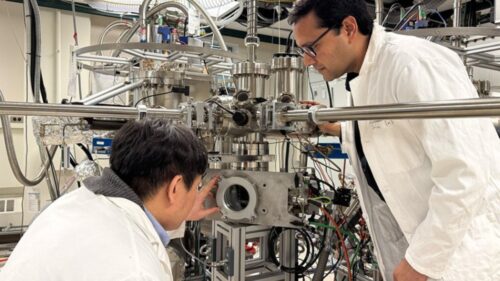
Researchers at the University of Minnesota Twin Cities have shown that metals can be tuned at the atomic scale to change electronic properties, challenging the view that metallic materials are fixed in behavior. The findings introduce a way to engineer electronic performance by adjusting atomic structure instead of changing chemical composition.
The study shows that shifts in atomic arrangement at material interfaces—the boundaries where two materials meet—can alter how electrons behave. By controlling these interfaces at the nanometer scale, the researchers produced changes in electronic properties relevant to semiconductors, catalysts, and quantum systems.
A key result came from experiments on Ruthenium dioxide, where researchers adjusted the thickness of thin films to control the material’s surface work function, a property that determines how electrons move across a surface. Those adjustments produced shifts greater than one electron volt.
The strongest effects appeared when the metallic film reached about four nanometers thick—roughly the width of a DNA strand. At that scale, the material shifted from a strained state to a relaxed state, creating structural distortions that changed its electronic behavior. The results show that atomic packing can reshape surface electronics.
The mechanism behind the shift lies in polarization effects that emerge at material boundaries. The interface between different atomic structures created conditions that allowed researchers to influence electron movement in metallic systems.
The findings point to interface engineering as a strategy for designing materials. Instead of relying on chemical modification or fabrication changes, engineers may be able to control electronic behavior through structural tuning.
For industries that depend on controlled electronic properties—including semiconductor manufacturing, clean energy systems, and quantum computing—the work offers a framework for materials design. More broadly, it suggests metals may be more adaptable than materials science has assumed.

