





A sensing platform combines color and 3D perception in one system, enabling machines to interpret environments with context, precision, and deployment capability.
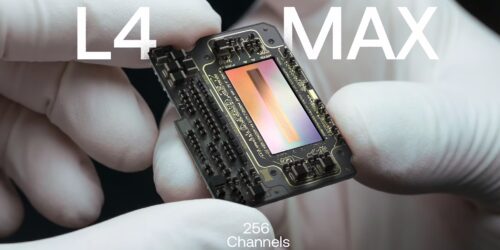
Rev8 is Ouster’s lidar platform with native color sensing integrated directly into the sensor architecture. Powered by the company’s L4 silicon, the platform combines 3D perception and color imaging in a single sensor system for autonomous systems, robotics, infrastructure, and Physical AI deployments.
At the center of the Rev8 lineup is the OS1 Max, a 256-channel lidar sensor capable of sensing up to 500 meters with a 45° field of view. The sensor provides twice the resolution of the Rev7 OS2 while occupying less space. The platform resolves small objects at long range and maintains spatial alignment between color and depth data.
The defining feature of Rev8 is native color lidar. Instead of relying on external cameras or software fusion, color sensing is implemented directly on the silicon. By combining color and depth perception with Fujifilm color science, Rev8 produces megapixel-resolution imaging with 48-bit color depth and 116 dB dynamic range. The system operates across lighting conditions ranging from 1 lux to 2 million lux.
The combination of structure and color expands what a lidar sensor can interpret on its own. A single sensor can distinguish brake lights, identify road signs, and generate colorized 3D maps without requiring separate imaging systems. For Physical AI applications, that reduces perception stack complexity and increases the amount of data available for model training and deployment.
The Rev8 platform is built on Ouster’s L4 silicon architecture, available in 128-channel and 256-channel variants. The chip integrates HDR imaging and delivers 42.94 GMACs of compute performance. It can detect up to 20 trillion photons per second, operate at 40 kHz measurement rates with picosecond timing precision, and process up to 10.4 million points per second while supporting off-chip bandwidths up to 22.4 Gbps.
The goal behind Rev8 is to expand machine perception. Autonomous systems depend on the quality and reliability of sensor data. By combining 3D sensing and native color perception in a production-ready platform, Ouster is extending lidar beyond geometry into contextual environmental sensing.
Click here for the original announcement.

