




Reference design enables isolated AC voltage sensing for motor control, charging, and power applications, supporting accurate monitoring of high-voltage systems.
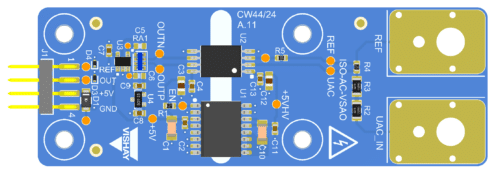
A reference design from Vishay gives isolated AC voltage sensing and produces a single-ended analogue output, enabling AC voltage sensing up to 400 V RMS. The device is ideal for applications where high voltages have to be monitored such as motor control, power supply systems, charging stations, and EV powertrain. The reference design supports a maximum working isolation voltage of 1200 V RMS and a bandwidth of 300 kHz respectively.
The reference design makes use of the isolation amplifier and discrete TNPV resistor voltage divider. The high voltage AC signal is first reduced by the voltage divider, then fed to the isolation amplifier. The isolation amplifier produces an isolated differential output which is then converted to a single-ended output between 0 V and 2.5 V.
As per Vishay, the isolation amplifier provides a linear differential input span of ±250 mV and differential output span of ±2.05 V. This IC exhibits very low offset and gain drift. In addition, this IC can handle a common mode transient immunity (CMTI) of 100 kV/µs.
ACAS resistor networks are used in the circuit for converting differential inputs to single ended output to minimise thermal drift and provide matched resistor values over a wide range of temperatures. The total signal chain includes an isolation amplifier gain of 8.2 and a differential to single-ended conversion gain of 0.5.
The reference board operates from a 5 V DC power supply and has a typical power consumption of 300 mW. The board provides a 1.25 V reference output and supports an output bandwidth of up to 300 kHz. The board is able to tolerate a maximum rated isolation voltage of 5000 V RMS, a transient isolation voltage of 7071 V peak and a repetitive isolation voltage of 1697 V peak.
The purpose of this reference design is to enable developers of high voltage sensing applications requiring galvanic isolation, wide bandwidth and analogue output.
Vishay has tested this reference design. It comes with a bill of materials (BOM), schematics, assembly drawing, printed circuit board (PCB) layout, and more. The company’s website has additional data about the reference design. To read more about this reference design, click here.

