Humans have been fascinated with humanoid machines even before modern engineering made them possible. From Greek mythology to ancient folklore to early science fiction, human-like machines have reflected people’s curiosity about intelligence and autonomy. Over time, literature and film have reinforced the idea that advanced machines may one day walk, talk, move, and interact in ways that resemble humans. Recently, technologies have matured enough to make these machines more practical outside of research labs, universities, and science fiction. Advances in sensing, actuation, artificial intelligence (AI), power electronics, and embedded computing are moving humanoid robots from imagination into the real world as functional machines. The history of humanoid robots and the technologies driving their rapid development often differ from what most people think.
For most of history, these visions have been constrained by a lack of technology. Insufficient computing power, crude actuation, and minimal sensing made humanoid robots pretty much impractical, much less a mirror of human movement and intelligence. What changed was not the desire to build human-like machines, but the technologies to actually build them. Faster processors and better sensors now allow humanoid robots to perceive their environments and respond in real time.
History of Humanoid Robots
The story of humanoid robots is easiest to understand when broken into a few key phases.
Early Mechanical Automation
Some of the earliest humanoid machines were purely mechanical. Renaissance-era designs that are attributed to Leonardo da Vinci included an articulated humanoid knight that aimed to mimic basic human motion (Figure 1). 1 Later, clockwork automations, often built for public demonstrations, showcased the impressive mechanical craftsmanship of gears, pulley systems, and cranks. But all of these machines lacked any autonomy or adaptability.

Early Electromechanical Humanoids
In the early 20th century, humanoid machines combined motors and basic control logic. Robots such as Eric and Elektro demonstrated speech, arm motion, and simple interactions.2 They represented a transition from purely mechanical mechanisms to electrically actuated systems.
Bipedal Research
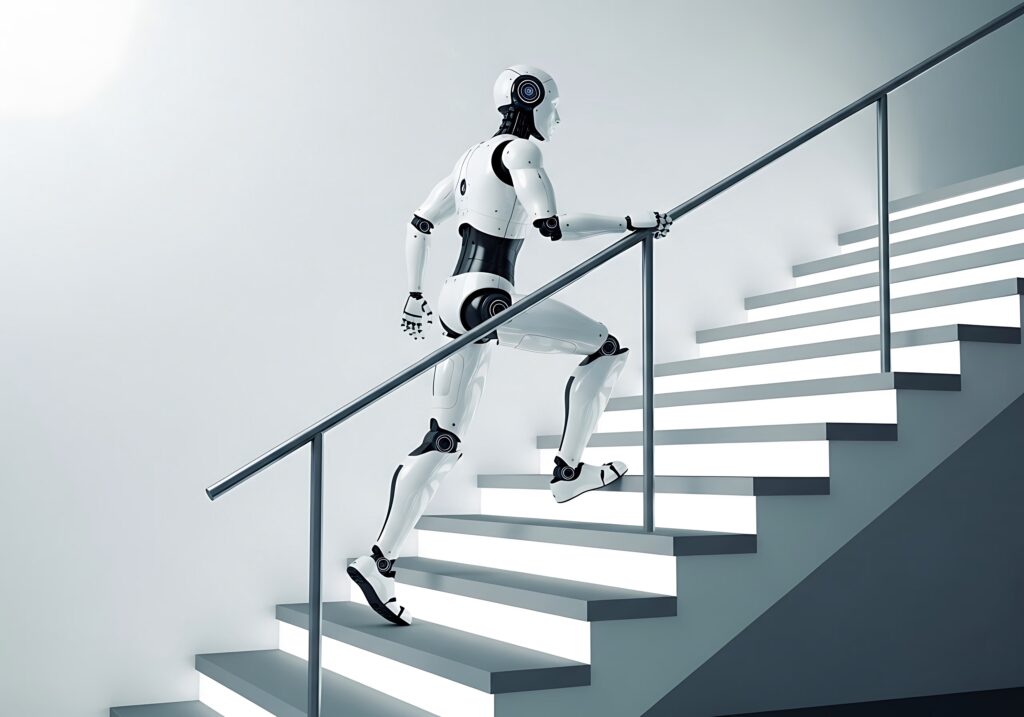
In the late 20th century, researchers began studying bipedal locomotion because it was one of the primary challenges hindering the development of humanoid robots. Honda’s E-series, P-series, and ASIMO robots demonstrated that humanoid robots could walk, climb stairs, and avoid obstacles.3
Modern Acceleration
In the last decade, the development of humanoid robotics has accelerated even more rapidly. Robots such as Boston Dynamics’ Atlas and Figure AI’s Figure robot represent significant advances in fluid human-like motion, perception, and autonomy.4 These robotic systems operate in real time and are only possible because of AI models, edge computing, embedded processors, and simulation-driven development that trains robots before they reach the real world. Robots can spend years learning to move and perform tasks in physics-based virtual environments before deployment.
Technologies Behind Today’s Humanoids
No single breakthrough is driving the advancement of humanoid robots. Instead, several simultaneously maturing technologies are enabling these robots to become a reality.
Sensing
Modern humanoid robots rely on multiple sensor types that work concurrently to perceive their environment. Vision systems provide object recognition and spatial awareness, while depth sensors and lidar enable navigation and obstacle avoidance. Force, torque, and tactile sensors allow robots to safely interact with the environment in scenarios such as object and tool handling and human interaction.
Actuation and Mobility
Most traditional industrial robots are fixed in place, attached to floors, ceilings, and walls in structured work cells.5 Humanoid robots, on the other hand, must dynamically balance, absorb impacts, and adapt to uneven terrain while in motion. Electric actuators with precision torque control and advanced control algorithms coordinate dozens of joints at once to create human-like motion. This coordination enables their walking, lifting, and object manipulation.
AI and Learning
AI gives humanoid robots perception, planning, and adaptive behaviors. In most systems, machine learning (ML) is used for visual recognition, task planning, and real-time motion optimization. Large language models (LLMs) are used to interpret instructions and sequence tasks rather than control movement directly.
Much of the training occurs in simulation environments where robots can practice movement and task execution before deployment. These environments allow robots to accumulate thousands of hours of experience in a shorter timeframe, without the wear, risk, or downtime associated with physical testing.
Compute Architecture
To handle the real-time control and perception, humanoid robots need substantial onboard computing to keep latency low. Edge processors manage real-time control, with graphics processing units (GPUs) and neural processing units (NPUs) supporting perception and planning. 6 This helps the robots operate safely without constantly relying on cloud connectivity.
Power and Thermal Management
Power remains one of the biggest obstacles in humanoid robot technology, especially when the robots need to operate in environments with many variables. Today’s systems rely on incremental improvements in battery technology. Modern batteries can supply enough energy to support short bursts of heavy mechanical load during physical tasks, even though overall runtime is still limited.
Advancements in thermal management are allowing these systems to maintain performance without overheating in increasingly compact designs. For example, engineers are embedding heat-pipe heat sinks directly inside robot joints and limb structures to conduct heat out of confined motor housing and spread it over larger surfaces for dissipation.7
Connectivity
Wireless connectivity plays a supporting role in the development and improvement of humanoid robots. These robots must operate independently in human environments, so wireless connections allow updates and development data to be spread across deployed systems. Data collected from multiple robots can be analyzed offline to improve models and make humanoid robots more reliable before any more updates are rolled out. Over time, this approach helps them perform consistently in places that were originally built for humans.
Why Use a Human Form?
Because most environments are built for the humans living in them, pursuing humanoid form is a practical design choice.
Doors, stairs, tools, workstations, and nearly every other structure were designed for human interaction. Rather than redesigning infrastructure, engineers can develop humanoids that operate within existing spaces and specifications (Figure 2).
In industrial settings, companies are exploring the use of humanoid robots for picking, palletizing, inspecting, and material-handling tasks that often require flexibility and decision-making rather than speed. In manufacturing, humanoid robots offer dexterity and adaptability, enabling them to perform tasks that are difficult to automate with fixed robots, such as robotic arms.
In healthcare settings, humanoid robots could help patients move more safely and reduce the physical burden on caregivers. In disaster response scenarios, humanoid robots can be designed to navigate hazardous environments, including fires, radiation, and even unstable structures. They can also be used as research platforms to study human-robot interaction and collaborative behavior, particularly in complex or unpredictable settings.
Common Misconceptions
One of the biggest misconceptions of humanoid robots is that they are designed to replace human workers completely. However, organizations state their intention is to assist with repetitive, physically demanding, or hazardous tasks.8 This is no different from how fixed robots have assisted in the past and continue to do so. Another common misconception is that humanoid robots will become emotional or even sentient. Despite the many advances in AI, they remain engineered systems that execute programmed objectives.
While some critics assert that humanoid robot technology is not ready for widespread adoption, analysts and industry reports consistently note that cost—rather than technical capability—is perhaps the biggest barrier. Although technologies supporting mobility, sensing, and autonomy have advanced rapidly, humanoid robots remain significantly more expensive than fixed or task-specific robots in use today. This barrier limits adoption outside of testing programs. Reports show that current humanoid systems frequently cost tens of thousands to hundreds of thousands of dollars per unit.9 Enabling broader scale will require substantial cost reductions alongside improvements in safety, durability, and uptime.
While humanoid robots function effectively in controlled environments, scaling production and reducing system costs will help determine the adoption rates. Most near-term applications will be for industrial and commercial use. Early customer-facing robots like SoftBank Robotics’ Pepper and NAO platforms are moving beyond demonstrations.10 Companies like UBTECH (with its Walker X robot), 1X Technologies (Eve), and Sanctuary AI (Phoenix) are actively developing humanoid robots for public-facing environments in places where interaction and task assistance are more important than full autonomy.11
The Next Decade of Humanoid Robots
Over the next decade, humanoid robots will advance through steady engineering rather than dramatic breakthroughs. One area that is likely to see active advancement is sensing, where newer systems are incorporating better visual perception and more capable tactile feedback, enabling robots to detect finer contact forces and better handle objects (Figure 3).
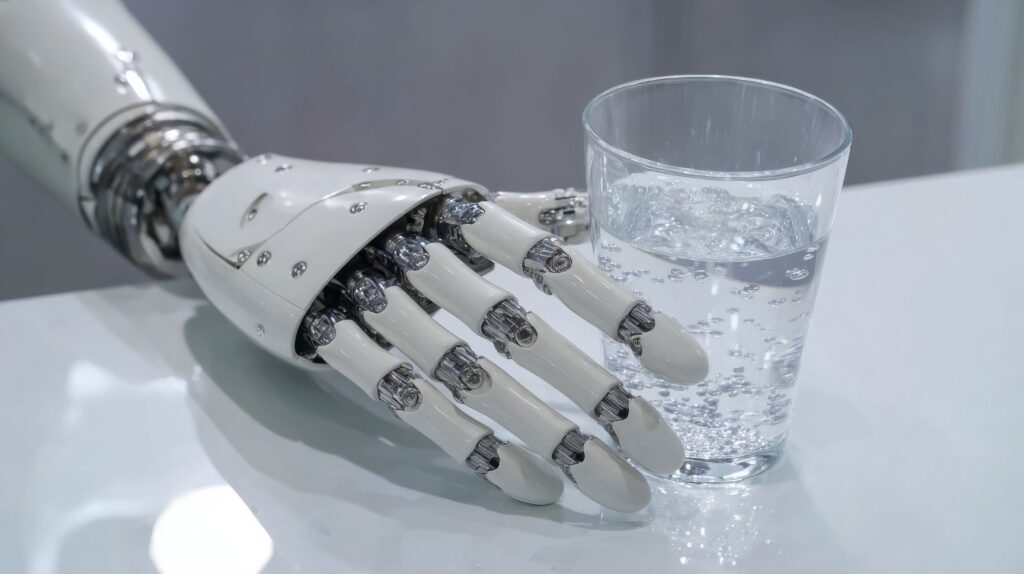
These sensing advances will expand the range of applications for humanoid robots. In industrial and utility settings, improved perception and control enable inspection, material handling, and maintenance in environments that are difficult to automate with fixed equipment. The use of humanoid robots is also being explored in warehouse and logistics roles where flexibility is more important than cycle time (for example, when handling mixed inventory or navigating spaces designed for human workers).
Healthcare and mobility assistance are other areas of near-term focus for incorporating humanoid robots, though the focus is not on full autonomy. Instead, potential applications focus on physical support tasks, such as assisting with patient movement and rehabilitation exercises. These applications depend on reliable sensing and controlled physical interaction. Incremental improvements in these areas will help make real deployment feasible.
As simulation tools improve, more of a humanoid robot’s behaviour can be developed and validated before the hardware is built, reducing iteration time and making larger-scale deployment more realistic over the next decade. This supports faster deployment in controlled commercial settings and will help with niche applications, such as training simulations and humanoid stunt doubles for film production, where repeatability and safety are essential.
Even broader adoption will depend on ongoing progress in cost, durability, and system reliability, rather than just technical capability. As engineers address the technological constraints, humanoid robots will likely move from experimental demonstrations to practical automation in environments that benefit from human-scale mobility and interaction.
Conclusion
Humanoid robots are an engineering reality no longer constrained by basic feasibility. Progress in this field is guided by existing technologies, such as sensors, power electronics, embedded computing, materials, and AI. In the next decade, deployment will be focused within industrial and commercial environments where flexibility is important, and wider use will depend on continued improvements in economics and durability rather than intelligence alone.
References
[1]https://en.wikipedia.org/wiki/Leonardo%27s_robot
[2]https://collection.sciencemuseumgroup.org.uk/objects/co8564641/replica-of-eric; https://spectrum.ieee.org/elektro-the-motoman-had-the-biggest-brain-at-the-1939-worlds-fair
[3]https://global.honda/en/ASIMO/history/
[4]https://bostondynamics.com/atlas/; https://www.figure.ai/figure
[5]https://ifr.org/industrial-robots
[6]https://www.nvidia.com/en-us/autonomous-machines/embedded-systems/
[7]https://walmatethermal.com/humanoid-robot-thermal-management-application-practice-of-walmate-thermal-heat-pipe-heat-sink
[8]https://www.reuters.com/technology/chinas-humanoid-robots-will-not-replace-human-workers-beijing-official-says-2025-05-17/
[9]https://www.mckinsey.com/industries/industrials/our-insights/humanoid-robots-crossing-the-chasm-from-concept-to-commercial-reality/
[10]https://us.softbankrobotics.com/
[11]https://www.ubtrobot.com/en/humanoid/products/walker; https://www.1x.tech/eve; https://www.sanctuary.ai/blog/sanctuary-ai-unveils-phoenix-a-humanoid-general-purpose-robot-designed-for-work
[12]https://talkinglogistics.com/2025/10/01/humanoid-robots-in-logistics-early-curiosity-lingering-skepticism
[13]https://arxiv.org/pdf/2509.14687
[14]https://spectrum.ieee.org/amp/mit-dynamic-acrobatic-humanoid-robot-2653906657
[15]https://straitsresearch.com/report/humanoid-robot-market
By Bryan DeLuca is a seasoned electronics content creator with a deep passion for demystifying complex engineering concepts. Through years of hands-on experience, he has built a reputation for translating advanced electronics topics into practical, engaging content for engineers, hobbyists, and makers. Bryan produces technical articles and videos that focus on components, power electronics, additive manufacturing, and the integration of microcontrollers, LEDs, and sensors.