More than 20 SiC power modules support solid-state transformers, EV fast chargers, smart grids, and renewable energy systems.
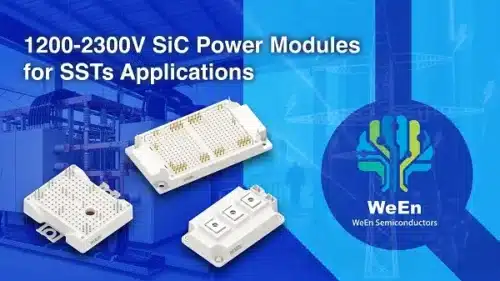
WeEn Semiconductors has introduced a new family of silicon carbide (SiC) AC-DC and DC-DC power modules for solid-state transformers (SSTs), EV fast chargers, smart grids, and renewable energy systems. The new portfolio includes more than 20 modules designed for high-efficiency power conversion and supports a range of system requirements with different package options and custom configurations.
The modules are available with voltage ratings from 1200 V to 2300 V and RDS(on) values as low as 1.5 mΩ. The company also offers customer-specific configurations for applications with different power and packaging requirements.
The new modules are designed for SSTs, which can achieve power conversion efficiencies of around 98%. One target application is grid power factor correction (PFC) for AI data centre racks, enabling direct conversion from 35 kVAC to 800 VDC in a single stage.
The portfolio includes 3-level topology modules, such as WMSC5R0N17B3T, for lower electromagnetic interference (EMI), and 2-level topology modules, such as WMSC5R0F23B3T, for simpler control and smaller system size.
WeEn has also introduced a range of half-bridge SiC modules for LLC and Dual Active Bridge (DAB) primary and secondary power conversion stages. These are available in B2, B3, and 62 mm screw-mount package options.
According to the company, all modules are built with low inductance to reduce switching losses and simplify system layout. The pin arrangement provides space for gate-driver circuits while supporting device integration and electrical safety.
Customers can also customise module features, including direct bonded copper (DBC) substrates, case materials, silicone gel, mounting options, pin types, plating, and pre-applied thermal interface materials, through WeEn Semiconductors’ custom design service.
Kevin Shen, President of WeEn Semiconductors, said: “We’ve launched the new WMSC modules that cover roughly 90% of all SST applications and these are also ideally suited to the smart grid, renewables and other high-voltage systems. They are a significant breakthrough for the industry and offer higher switching speeds and higher breakdown voltages, which in turn allows for direct connection to the medium-voltage grid as well as reduced magnetics, higher efficiencies and simplified cooling.”