




A vibration sensor uses on-sensor AI to detect equipment issues, support predictive maintenance, and reduce industrial downtime.
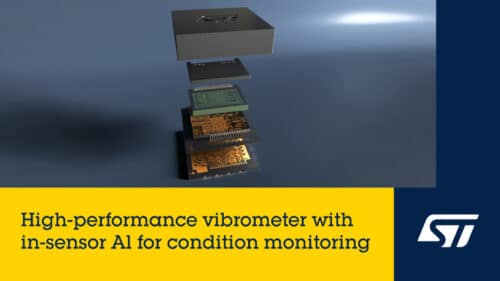
STMicroelectronics has introduced the IIS3DWB10IS intelligent vibration sensor for industrial condition monitoring applications that require high accuracy, reliability, and energy efficiency.
Built using ST’s MEMS (micro-electro-mechanical systems) technology, the IIS3DWB10IS integrates an intelligent sensor processing unit (ISPU 2.0) that brings digital signal processing and artificial intelligence (AI) inference closer to the sensing element. The sensor measures vibrations and shocks up to 200g at frequencies of 10kHz and above. It also supports a wide operating temperature range of up to 125°C for use in harsh industrial environments.
The sensor is designed to help improve equipment uptime, reduce unplanned downtime, and support predictive maintenance strategies. Vibration analysis is widely used in condition monitoring because many industries rely on rotating and oscillating machinery for cutting, shaping, moving, cooling and other processes.
Early detection of equipment issues, such as predicting bearing failures, can help prevent equipment stoppages. This allows industries, including automotive and other manufacturing sectors, to monitor machinery and maintain production flow.
“Our industrial MEMS vibration sensor delivers the dynamic range and bandwidth needed for high-end applications and extends the advantages of ST in-sensor digital processing. Integrating the ISPU 2.0, with its new hardware accelerators for fast signal processing and AI inference, sharpens equipment-wear recognition while reducing latency and power consumption,“ said Simone Ferri, APMS executive VP MEMS sub-group. “Industries can expect a new generation of condition monitoring sensors, the first compelling alternative to piezosensors, that is lightweight, easy to fit and design, ultra-accurate, and energy efficient enough for battery-powered operations.”
“The IIS3DWB10IS delivers unique properties for our target markets and environments. Its high dynamic range, wide bandwidth, and high-temperature capability, combined with ease of adoption and a cost-effective, simplified circuit design, allowed us to replace the incumbent piezosensor technology. Moreover, the integrated ISPU 2.0 processor positions complex signal processing and rapid AI inference close to the sensing element, enabling smarter system responses,” said Andrea Torcelli, chief technology officer at Bonfiglioli S.P.A.
Click here for the original announcement.


