




The reference design optimizes power design for ADAS applications, providing an integrated solution with a compact size and simplified implementation.
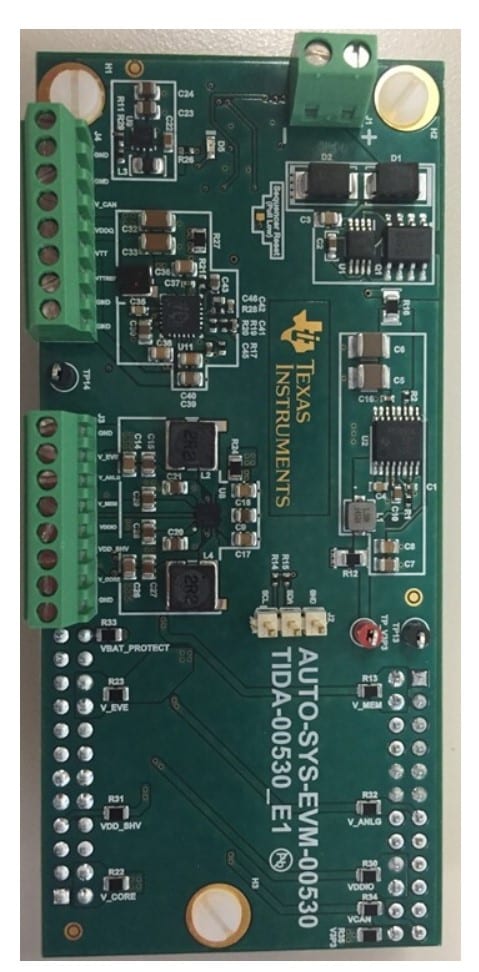
Automotive Power is necessary for Advanced Driver Assistance Systems (ADAS) systems to power sensors, enable data processing and computation, facilitate actuation and control, and provide fail-safe mechanisms for enhanced safety and performance. Texas Instruments (TI) simplifies the design process by introducing an automotive power reference design. This integrated solution optimizes power design for ADAS applications, offering a compact size and simplified implementation. The system is a comprehensive power solution specifically designed for low-power ADAS processor applications, encompassing critical peripheral power. The design provides power for Controller Area Network (CAN) physical layer (PHY) and Double Data Rate version 3 (DDR3) memory. The system is designed to operate within the full range of battery conditions of 3.5V to 42V, ensuring compatibility and functionality across various voltage levels.
With a current usage of approximately 2.1 A, the reference design provides sufficient headroom with a device maximum of 3 A. The device operates at a nominal switching frequency of 2.1 MHz in Pulse width modulation (PWM) mode. In space-constrained applications, device integration is of utmost importance. Hence the design comprises two buck converters and two Low dropout regulators (LDOs) in a compact ball grid array (BGA) package to meet the requirements of small and efficient designs. The automotive power system efficiently utilizes 1 GB of DDR3 memory, which is ample for targeted low-end processing applications. With a current draw of just 1 A, it provides more than enough headroom for all tasks.
To optimize it for CAN PHY applications, the design incorporates a fixed 5V boost converter that operates at a frequency of 3.5 MHz, safely above the amplitude modulation (AM) band. This design efficiently supplies the necessary 5V at 200 mA by minimizing the need for external components, resulting in a streamlined overall design. The reference design is equipped with the Smart Diode Controller that effectively fulfills the need for reverse-battery protection across all electrical subsystems. Each block of the design is optimized for the smallest possible solution size. Example applications of the design include smart rearview cameras, low-end mono front cameras, and multi-mode radar (SRR and MRR) systems.
This reference design has been tested by TI. It comes with a Bill of Material (BOM), schematics, Gerber file, Printed circuit board (PCB) layout, computer-aided design/ computer-aided engineering (CAD/CAE) symbols, etc. You can find additional data about the reference design on the company’s website. To read more about this reference design, click here.

