




What if three-phase power conversion could become smaller and reach nearly 99% efficiency while enabling bidirectional energy flow and grid support?
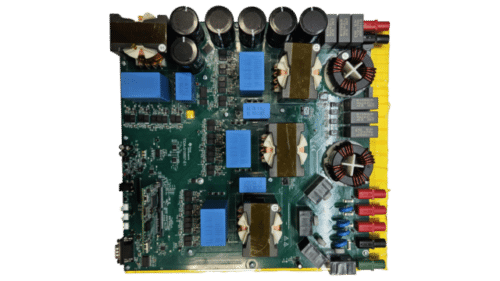
TIDA-010957 is a reference design from Texas Instruments (TI) that provides design engineers with a validated framework for developing high-density three-phase power conversion systems using a three-level flying capacitor Gallium Nitride (GaN) topology. The design supports DC bus voltages up to 900 V while using 650 V-rated power devices, achieves peak efficiency up to 98.9% at full load, and operates at an equivalent switching frequency of 125 kHz to reduce filter size and improve overall power density.
You can use the platform to develop string inverters, central inverters, onboard chargers, DC fast charging stations, power conversion systems (PCS), and uninterruptible power supplies (UPS). The architecture also supports bidirectional power flow and reactive power compensation, making it suitable for storage-ready inverter platforms and grid-interactive energy systems.
The three-level flying capacitor topology allows the converter to distribute voltage stress across multiple switching devices instead of exposing each transistor to the full DC bus voltage. In this implementation, every power device experiences only half of the DC link voltage stress. This enables engineers to use faster lower-voltage GaN devices in high-voltage applications where conventional half-bridge topologies would normally require higher-voltage semiconductors.
By combining the multilevel architecture with high-speed GaN switching, the design increases switching frequency while reducing switching losses. Operating at an equivalent switching frequency of 125 kHz allows engineers to significantly reduce the size of output inductors and filter components, enabling more compact converter and inverter designs with higher power density.

The platform further demonstrates bidirectional DC/AC power conversion using the same hardware stage. Through software control, the converter can operate either as a solar inverter or as a Power Factor Correction (PFC) stage. The design has also been validated for both injecting and absorbing reactive power independently on each phase, supporting advanced grid-management and energy-storage applications.
The reference design aligns with the ongoing transition toward higher-voltage solar and energy storage systems operating at 1000 V and 1500 V DC. Higher PV string voltages allow systems to deliver the same power at lower current levels, reducing conduction losses and improving overall efficiency. The multilevel flying capacitor approach helps address the increased voltage stress associated with these higher-voltage systems while maintaining high switching performance and compact system design.
TI has tested this reference design. It comes with a bill of materials (BOM), schematics, assembly drawing, printed circuit board (PCB) layout, and more. The company’s website has additional data about the reference design. To read more about this reference design, click here.

