




Reference design demonstrates a hardware-only e-fuse architecture for high-voltage AC and DC systems with configurable protection, bidirectional current blocking and modular implementation.
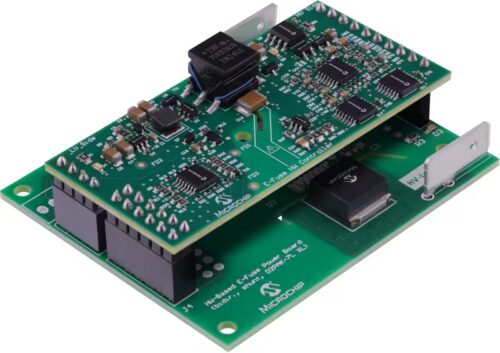
Microchip has announced a reference design for a hardware-based high-voltage e-fuse for industrial, electric vehicles, aerospace and defence, data centres, grid and microgrid. The solution is designed to be used in bidirectional alternating current (AC) and direct current (DC) electrical distribution systems and it does not have a built-in microcontroller or a processor, making its implementation in functional safety design simpler. The solution can be implemented in 400V or 800V DC systems and support configurable current-trip profiles and bidirectional current blocking.
The reference design uses the modular approach as it splits the control and power boards into separate parts. The control board monitors voltage and current, generates control signals and manages system protection, while the power board consists of silicon carbide (SiC) power switches and a shunt resistor, which is needed for bidirectional current measurement. Shunt resistor positioning allows measuring current in both directions, while SiC devices contained in D2PAK-7L XL packages improve thermal performance.
It offers features like fast shutdown on overload within 1ms and fast shutdown on short-circuit within 1µs allowing fast fault isolation. The hardware-based approach is also capable of resetting, hence making it easy to be serviced and packaged. In addition, there is the provision for fast fault detection in high voltage AC and DC power systems, configurable current-trip profiles and discrete component scalability.
The design operates from a nominal 12V low-voltage supply while consuming less than 100mA of input current. High voltage operational ranges supported by the system are 400V to 800V in the reference design while according to the user guide, high voltage input is 500V for implementations with 700V SiC metal-oxide-semiconductor field-effect transistors (MOSFETs) while that of 1000V is for those with 1200V SiC MOSFETs. High voltage output current varies depending on the choice of SiC devices.

Target use cases for this solution include battery disconnect units (BDUs), on-board chargers (OBCs), low-voltage DC/DC converters, cabin heater, AC compressor inverters, and other high-voltage loads that need reliable protection and fault management. This reference design comes with auxiliary resources to help engineers evaluate and adapt the design according to their HV power systems. These resources include a user guide, Altium design files, and bill of materials (BoM).
The reference design combines hardware-only operation, modular architecture and fast protection mechanisms to support the implementation of high-voltage e-fuse systems for industrial and automotive power applications.
Hardware resources as well as supporting documents have been included in the reference design to support evaluation and development of isolated power-supply designs. They include schematics, PCB files and connection diagrams.
For more information, click here.

