





Design demonstrates multi-motor field-oriented control for industrial automation, robotics and appliance systems.
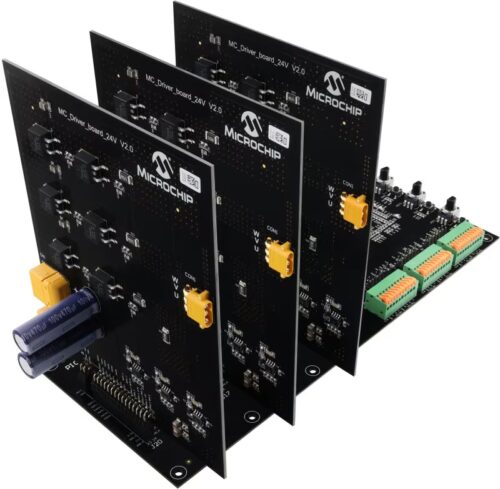
A reference design from Microchip demonstrates how a 32-bit microcontroller platform can control up to three PMSMs. The design features modular hardware coupled with pre-configured software projects to address applications like industrial automation, robotics, home appliances requiring precise multi-axis motor control.
The design features a control board which is capable of being paired up with up to three driver boards to enable configuration of one, two or three motors. Each motor channel comes with quadrature encoder interface, Hall sensor interface and over-current detector to enable sensored control and protection of the system. The control board includes three user-defined buttons, LEDs and potentiometers, as well as UART, SPI and CAN interfaces.
Driver boards can run either on shared or separate power supplies and support input voltages between 24 V DC and 48 V DC. They offer a rated phase current of 15 A RMS and a peak current of 30 A. Three-phase current, DC bus current and three-phase back EMF measurements are available for feedback.
The demonstration platform, according to the company, can provide support for field-oriented control using encoders and Hall sensors for each motor channel. Furthermore, it offers software-based determination of PI gains that simplifies the motor tuning process and saves time during development. Other features include configurable motor parameters, PWM periods and various rotor-angle calibration techniques, such as Hall-based callibration, index capture and index reset.
Microcontrollers forming the foundation of the platform are specifically designed for fast and efficient motor control. They have a CPU clocked up to 120 MHz, built-in floating point and mixed-signal peripherals. The microcontroller family includes up to seven 12-bit ADCs with a combined throughput of 25.45 Msps along with other peripherals like op amps, comparators and PWM modules. In addition, there are communication interfaces, namely, USB, CAN FD, SPI, I2C and UART.
Software resources that complement the reference design include examples for both sensored and sensorless field-oriented control. By means of scalable hardware, configurable feedback and flexible software tools, the platform is designed to help developers accelerate multi-motor system development in industrial, appliance and robotics applications.
For more information, click here.

