

Using an isolated sensing architecture, the circuit converts high DC voltages while maintaining electrical isolation between the input and measurement circuitry.
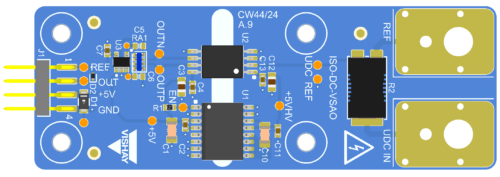
In high voltage systems like EV powertrains, battery monitoring systems and EV charging stations, the need to accurately measure voltages without a direct electrical connection is essential. The design, developed by Vishay, enables isolated measurement of DC voltages from 0 to 1000V and has an analogue output of 0 to 2.5 V.
The circuit uses a high voltage resistor divider and an isolation amplifier to measure the high voltage accurately and to galvanically isolate the high voltage input from the measurement circuit. The resistor divider steps down the input voltage to match the input range of the isolation amplifier that outputs the isolated analog signal.
The differential output from the isolation amplifier is converted into a single-ended output signal by the use of a separate conversion circuit. This design also employs a precision resistor network with well-matched resistance values over a wide temperature range to minimise thermal drift.
The voltage divider uses thick film resistors and supports operating voltages of up to 1500 V. The voltage divider has an accuracy of up to ±0.5 per cent. It also has a low temperature coefficient of 10ppm per degree Celsius, sulphur resistance, and automotive qualification.
The sensor circuit can support up to 1200 VRMS for maximum isolation voltage and has a bandwidth of 290 kHz. This enables it to capture fast-varying voltage signal values. It uses 5 V DC power supply and produces a single ended output of 0-2.5 V.
This design is applicable for motor control systems, power supplies, battery management systems, charging stations, and EV powertrains. The reference package includes the design board along with all the files required for evaluation and development of isolated high voltage sensing applications.
Vishay has tested this reference design. It comes with a bill of materials (BOM), schematics, assembly drawing, printed circuit board (PCB) layout, and more. The company’s website has additional data about the reference design. To read more about this reference design, click here.