




A computer built with a 2D semiconductor integrates more than 1,400 transistors on one chip, demonstrating a path toward AI and edge computing.
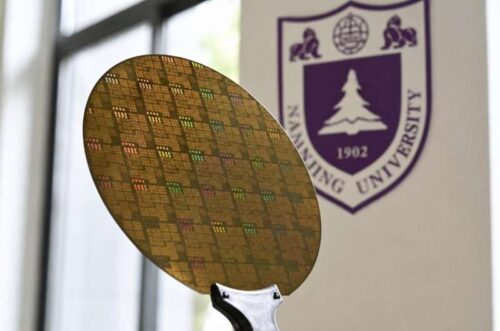
Researchers from Nanjing University, Suzhou Laboratory, and Huawei Technologies have developed a computer built using the two-dimensional (2D) semiconductor molybdenum disulfide (MoS₂). The system integrates more than 1,400 transistors on a single chip and is designed for artificial intelligence and data-processing applications.
The development comes as AI systems such as ChatGPT, Gemini, and other machine-learning platforms continue to increase computing and power demands. Engineers have been exploring alternatives to silicon-based technologies to improve energy efficiency while maintaining computing performance.
The computer is based on MoS₂, a semiconductor material that is a few atoms thick. Researchers believe that 2D semiconductors could help address scaling challenges faced by silicon transistors as device dimensions continue to shrink.
Unlike previous demonstrations that focused on individual devices or small circuits, the system combines more than 1,000 MoS₂ transistors into a computing platform. To achieve this, the team created a Multi-Level Co-Optimization (MLCO) design methodology that addresses fabrication, logic design, standard cell development, and interconnect routing.
The computer features a 4-bit parallel processor capable of executing eight instructions. Its architecture includes an instruction decoder, register file, arithmetic logic unit (ALU), and multiplexer. The decoder interprets incoming instructions and coordinates data movement and processing across the system.
According to the researchers, the 4-bit architecture allows the processor to handle four bits of data simultaneously, increasing processing speed compared with earlier 2D semiconductor computers that relied on 1-bit serial operation.
Using the MLCO approach, the team achieved a transistor density of 9,336 transistors per square millimeter. The researchers also demonstrated on-chip register file integration, removing the need for external storage used in previous 2D semiconductor computer systems.
The work provides a framework for developing integrated circuits based on 2D materials. Researchers see potential applications in edge computing, where local data processing can reduce dependence on cloud-based resources.
Future research will focus on improving transistor performance, increasing integration density, and scaling designs from thousands to millions of transistors per chip. The team also plans to explore combining 2D semiconductors with silicon technologies to create computing systems that use both material platforms.

