

A new 3D-printed zinc-ion battery combines high energy density and long cycle life, potentially supporting future grid-scale energy applications.
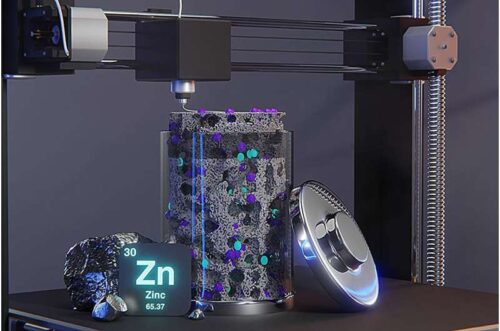
Scientists at the University of California at Los Angeles (UCLA) have developed a 3D-printed zinc-ion hybrid battery that stores more than seven times the charge of similar hybrid devices. This technology could provide a cheaper and more sustainable option for grid-scale energy storage because zinc is 100 times more abundant than lithium and easier to mine and recycle.
This hybrid device combines a battery-like energy-storage terminal with a carbon electrode similar to that used in supercapacitors. In order to improve the energy capacity of the device, researchers produced a honeycomb-shaped carbon electrode containing billions of microscopic holes and coated it with vanadium oxide. The surface area of such an electrode is so great that one gram of the material, if spread out, would cover ten tennis courts.
“The future of energy storage won’t be defined by a single technology,” said co-corresponding author Maher El-Kady, an assistant researcher in UCLA College’s chemistry and biochemistry department. “At some point, we will need to look for something to complement the current options for grid-scale energy storage. What we’ve done in this study essentially gives us zinc-ion hybrid devices that can store nearly one order of magnitude higher capacity.”
After 1,500 cycles, the battery had maintained 82% of its capacity. Additionally, the research team developed a cost-effective 3D-printed test cell with slots that hold electrodes at a fixed distance apart. When tested using standardised carbon electrodes, after 1,500 cycles, 98% of charge was maintained, whereas those tested in a conventional open-cell setup failed in fewer than 100 cycles.
“The method we used lets us build any 3D scaffold, layer by layer, and control its microstructure,” said co-corresponding author Ric Kaner, a UCLA distinguished professor of chemistry and biochemistry and of materials science and engineering. “We can actually have billions and billions of these tiny holes, producing an enormous internal surface area. That means we can store a lot of charge.”