




Researchers have improved organic solar cells with advanced molecules, unlocking higher efficiency, flexibility and the potential for widespread solar adoption.
As demand for greener energy solutions grows, organic solar cells (OSCs) are emerging as a lightweight, flexible and low-cost alternative to traditional inorganic photovoltaics. Their potential for large-scale applications, including agrivoltaics is substantial, but efficiency improvements are critical to make OSCs commercially competitive and widely deployable.
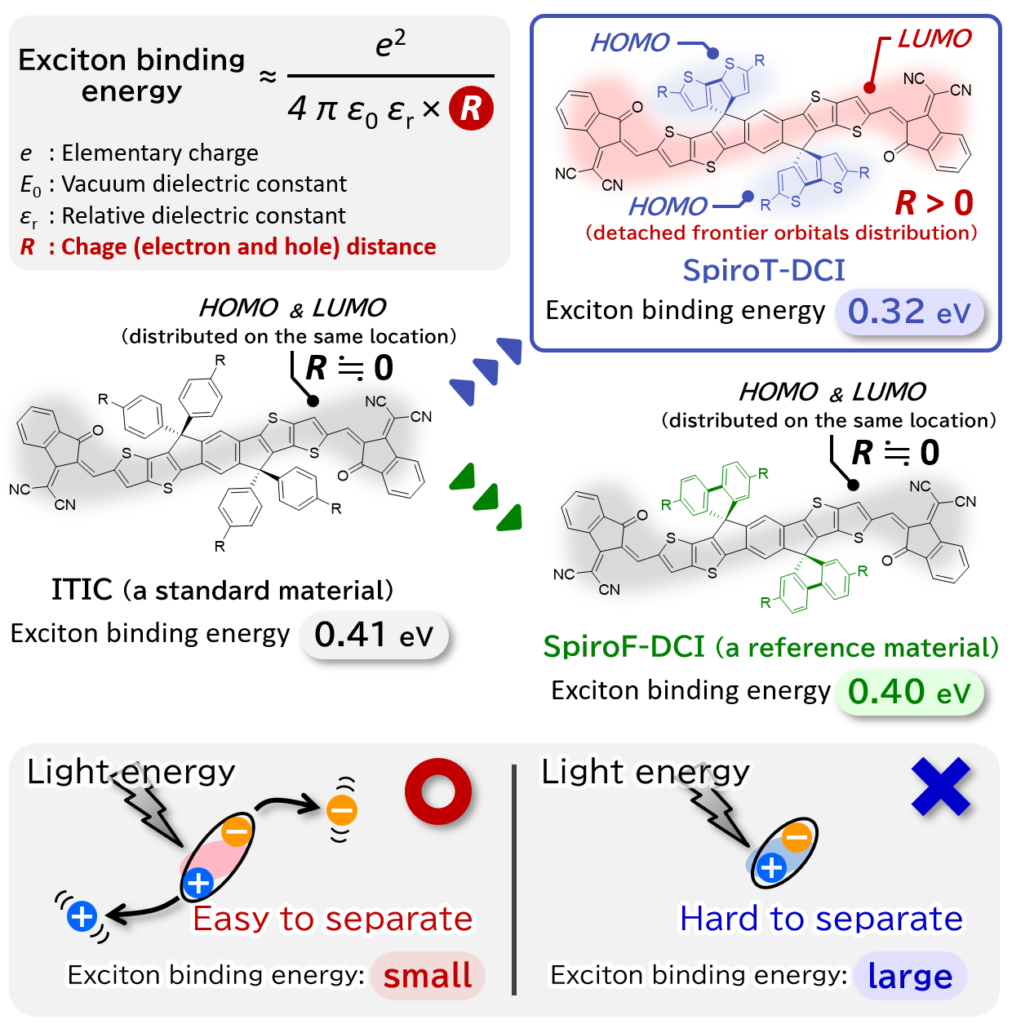
Researchers at Osaka University’s SANKEN Institute have addressed this challenge by developing a new organic semiconductor that significantly enhances power conversion efficiency. The team focused on exciton behaviour of the bound state of an electron and a hole generated by sunlight. Reducing exciton binding energy allows OSCs to convert light into electrical current more efficiently.
The researchers designed a novel acceptor molecule with side units that spatially separate the regions accommodating electrons and holes, lowering exciton binding energy and boosting performance. Both tested in single-component OSCs and bulk heterojunction devices, the molecule outperformed conventional standards.
Key features of the research include:
- Side-unit molecular engineering reduces exciton binding energy
- New acceptor molecule enhances charge separation and transport
- Improved power conversion efficiency in both single-component and bulk heterojunction OSCs
- Potential for wavelength-selective and transparent OSC devices
- Supports scalable, high-performance photovoltaic applications
Yutaka Ie, senior author of the research work, says, “The molecule we designed shows that the nature of side units in acceptor molecules is key to exciton behavior and overall device efficiency. This work demonstrates the potential of rational molecular design in advancing OSC technology.”
The findings highlight how precise molecular tuning can translate to meaningful efficiency gains, paving the way for high-performance OSCs and next-generation large-scale photovoltaic systems, advancing sustainable energy solutions globally.


