A new vision platform powered by dual AI engines and advanced imaging tools promises sharper defect detection, faster deployment, and greater reliability across automotive, electronics, food, and pharmaceutical production lines.
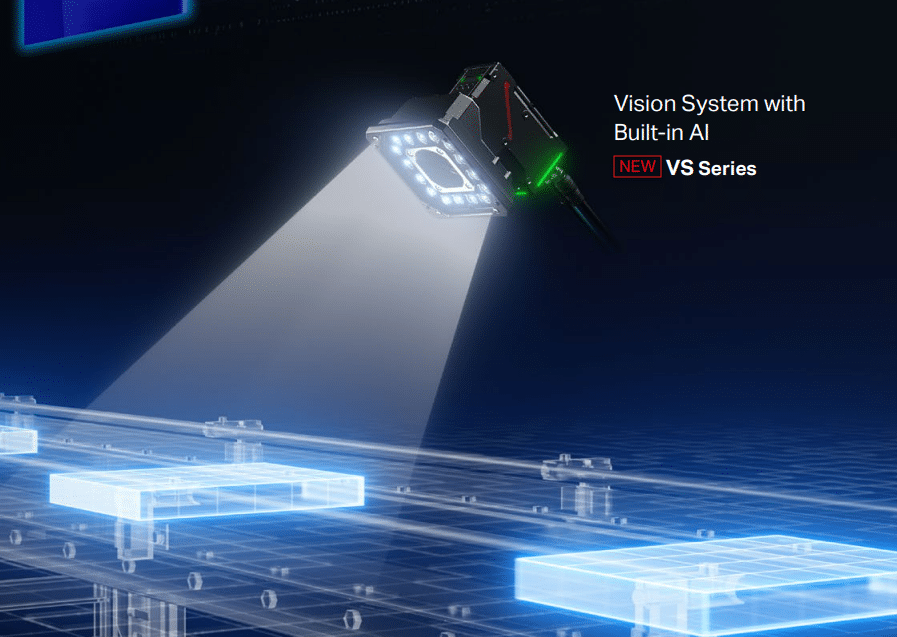
Keyence has launched its new VS Series, a vision system that integrates artificial intelligence to tackle inspection tasks that have long been considered impractical with conventional machine vision. The system combines supervised and unsupervised AI learning with rule-based tools, aiming to reduce false detections, prevent defective shipments, and improve overall production yield.
There are two AI-driven technologies. The first enhances detection accuracy through a proprietary smart camera algorithm capable of handling up to 25 megapixels, while the second accelerates deployment with a streamlined learning process requiring only a few dozen sample images on a standard PC. This lowers the barrier for adoption in factories that previously struggled with the complexity and training data demands of vision AI. The key specs include:
- Resolutions: 1.6 MP, 3.2 MP, 5 MP, up to 15 MP
- Proprietary CMOS sensors with minimal distortion
- Frame rates up to 85 fps
- AI Segmentation, Classification, Detection, and OCR tools
- Auto Image Selector for automatic training dataset creation
The lineup includes three camera configurations—standard zoom, short-range zoom, and C-mount—giving manufacturers flexibility for different fields of view, mounting conditions, and specialty lens use. Each camera integrates advanced imaging tools such as LumiTrax glare reduction, multi-spectrum lighting, and the optical ZoomTrax system, which enables resolution-preserving zoom without mechanical lens changes. Rated IP67 and designed with PoE connectivity, the cameras are built for harsh industrial environments and easy integration into existing equipment.
Beyond hardware, the VS Creator software and Vision Dashboard offer rapid inspection programming and real-time data visualisation. Customisable interfaces allow engineers to link inspection tools, generate reports, and tailor operation screens for onsite staff. Features like Capture Replication and Auto Image Selector further streamline deployment, enabling quick reproduction of lab conditions and automated selection of optimal training images.

Application examples span automotive, electronics, food, and pharmaceuticals—ranging from die-cast defect detection and IC mould inspections to packaging seal checks and medicine text verification. By combining AI-driven adaptability with rule-based precision.