

Cornell engineers have built a next-gen transistor on bulk aluminum nitride that runs cooler, handles higher power, and slashes gallium dependence, marking a potential shift in how future 5G, 6G, and defense-grade RF electronics are designed and manufactured.
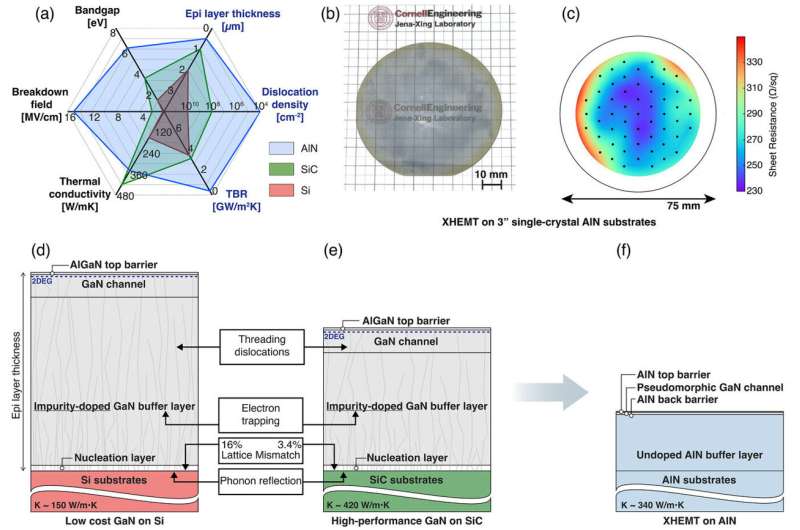
Cornell engineers have unveiled an aluminum-nitride–based transistor architecture that could shift the trajectory of high-power wireless systems, from 5G and early 6G infrastructure to advanced radar. The new device, an XHEMT built on bulk single-crystal aluminum nitride (AlN), promises higher power densities, cooler operation, and dramatically fewer material defects than today’s gallium-nitride platforms.
At the center of the breakthrough is a lattice-matched material stack: an ultrathin gallium nitride (GaN) layer grown on AlN, an ultrawide-bandgap semiconductor with naturally low defect densities and superior thermal conductivity. This pairing allows the transistor to withstand hotter, higher-voltage operation while curbing electrical loses key requirements as RF systems push deeper into high-frequency millimeter-wave territory.
For radio-frequency power amplifiers, which drive everything from telecom backhaul to defense radar, heat remains a performance bottleneck. Cornell’s researchers report that the high thermal conductivity of AlN keeps channel temperatures significantly lower than in GaN devices grown on silicon, silicon carbide, or sapphire. That thermal headroom, they say, could extend communication range, boost radar power, and improve long-term device reliability.
Another consequence of the AlN substrate is defect reduction. The XHEMT stack eliminates roughly a million-fold crystalline defects compared to conventional GaN-on-silicon or GaN-on-SiC HEMTs. Fewer dislocations mean improved carrier mobility, better device uniformity, and the potential for longer operational lifetimesfactors that determine the scalability of next-generation RF modules.
The work carries supply-chain implications as well. GaN demand is climbing across chargers, power electronics, and RF nodes, yet more than 90% of the world’s gallium supply sits outside the U.S. Export constraints and tightening availability have amplified concerns. By using only a minimal amount of GaNseveral orders of magnitude less than standard GaN HEMTsthe AlN-based XHEMT architecture reduces exposure to gallium bottlenecks.
The bulk AlN crystals used in the research were produced with Crystal IS in New York, one of the few companies capable of growing AlN at device-grade quality. Recent results also show wafer-scale XHEMT growth on 3-inch AlN substrates, pointing to a path toward manufacturable RF electronics built on U.S.-grown materials.Cornell’s interdisciplinary team contributed across materials development, epitaxial growth, device design, and atomic-scale characterization, marking a significant milestone in ultrawide-bandgap RF technology.