

With durability and fivefold higher efficiency than past designs, it could enable battery-free wearables and autonomous IoT sensors powered only by human warmth.
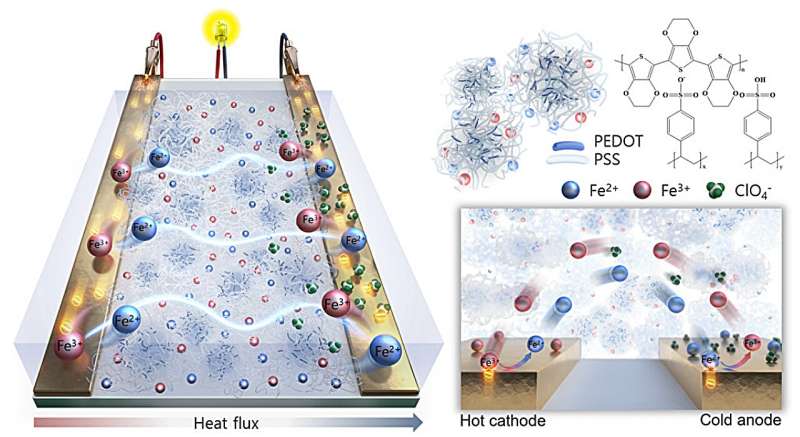
A team at the Ulsan National Institute of Science and Technology (UNIST) has created a solid-state device that can harvest body heat and convert it into usable electricity, potentially eliminating the need for batteries in wearable electronics and low-power IoT sensors. The advancement addresses a long-standing limitation in energy harvesting: the tiny temperature difference between human skin, which sits around 36°C, and the surrounding air, usually between 20°C and 25°C.
The innovation lies in the world’s first high-performance n-type solid-state thermogalvanic (TG) cell, developed under the leadership of Professor Sung-Yeon Jang. Unlike earlier thermogalvanic systems that struggled to deliver enough power for real-world applications, this design generates sufficient voltage and current to operate practical devices. Its solid-state form factor not only enhances safety by avoiding leakage but also improves ion transport, which has historically limited current output in such systems.
The team engineered a polymer-based electrolyte that supports efficient ion diffusion. Electrostatic interactions between polymer sulfonate groups and iron redox ions create a stable structure, while perchlorate ions remain mobile, boosting thermodiffusion and overall output. As a result, the device’s Seebeck coefficient—a measure of voltage generated per degree of temperature difference—reaches –40.05 mV/K, about five times higher than conventional n-type cells.
When assembled like LEGO bricks, 100 of these cells connected in series can produce around 1.5 volts, comparable to an AA battery. Larger modules built from 16 such series can directly power small electronics, including LED lights, clocks, and temperature or humidity sensors. Tests also showed the cells remain durable, maintaining performance after 50 charge-discharge cycles. By turning the body’s natural warmth into a power source, the new TG cells move a step closer to self-sustaining wearable electronics and autonomous IoT devices. Professor Jang emphasized that this milestone in low-temperature heat harvesting could help build flexible, battery-free systems that run solely on energy generated from the human body.