What happens when students stop building for grades and start building like engineers? This competition tested more than ideas. It tested real-world skills.
India’s electronics sector continues to face a problem. Students graduate with theoretical knowledge but limited exposure to engineering practice. Classrooms teach circuit theory, microprocessors, and programming basics, but industry demands experience in building, testing, documenting, and refining systems.
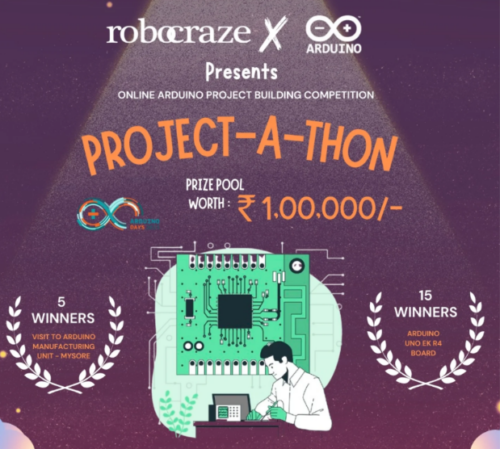
The Arduino Projectathon, organised by Robocraze, aimed to address this gap by placing students in a competition environment that reflected engineering workflows rather than prototype building.
Unlike project contests, participants were required to demonstrate the product development cycle. Teams submitted prototypes along with technical documentation, including project overviews, bills of materials, and circuit diagrams prepared using tools such as Fritzing and EasyEDA.
Code submissions included Arduino sketches with library references, enabling replication and modification by other engineers. The evaluation process assessed clarity, execution, documentation, and video explanations.
By emphasizing documentation and reporting, the competition addressed a weakness in engineering education. The assumption that technical ability alone ensures effectiveness does not hold true in industry. Communication, traceability, and record-keeping are also required in industrial settings.
The grand prize-winning team built a gesture-controlled robotics platform integrating computer vision, wireless communication, and mechanical design. Their Dynamic Gesture Robotics system used MediaPipe-based hand tracking to detect gestures in real time and translate them into robotic movement. Commands were transmitted using NRF modules, and the robot chassis was designed and 3D-printed to match actuators and sensors.
The second grand prize focused on healthcare response. The team developed an IoT-based system integrating GPS tracking and traffic management features to support ambulance movement. The project demonstrated integration across hardware, communication, and control layers.
Beyond cash prizes worth over ₹1,00,000, winners received access to the Arduino manufacturing facility operated by Kaynes Technology, Arduino’s manufacturing partner in India.
The Projectathon model showed how industry initiatives can supplement academic learning with practice-based experiences. Projects covered robotics, IoT-based home automation, environmental monitoring, and assistive technology.
As India expands its role in electronics design and manufacturing, such initiatives help strengthen skills and industry awareness among engineering students. By combining technical challenges with documentation and factory exposure, the competition created a pathway from classroom learning to industrial readiness.