




HomeElectronics NewsCamera Uses Focus Changes to Sense Distance

Camera Uses Focus Changes to Sense Distance

A 3D camera measures distance by comparing image blur, creating depth maps while using less power for wearables, robots, drones and assistive devices.
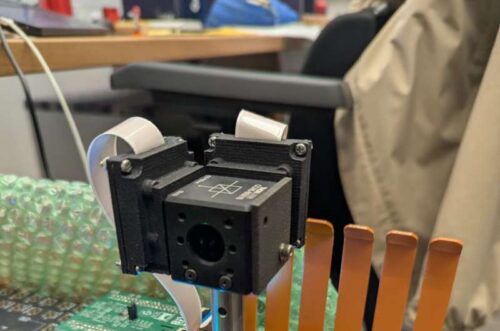
Called SpiderCam, the new device senses depth the same way that jumping spiders judge distances before making a high precision hop. The camera produces real-time 3D maps while consuming less than a watt of power. That's less energy than used by a standard nightlight. Credit: Emma Alexander/ Northwestern University
Called SpiderCam, the new device senses depth the same way that jumping spiders judge distances before making a high precision hop. The camera produces real-time 3D maps while consuming less than a watt of power. That’s less energy than used by a standard nightlight. Credit: Emma Alexander/ Northwestern University

Northwestern University engineers have developed SpiderCam, a 3D camera that generates real-time depth maps while consuming just 624 milliwatts of power. Inspired by the vision system of jumping spiders, the camera estimates distance by comparing blur differences between two images captured with slightly different focus settings.

Designed for battery-powered applications, SpiderCam could support wearables, assistive devices, robots and drones that require depth sensing without the power demands of conventional 3D cameras. The system produces depth maps at 32.5 frames per second while operating below one watt of power.

The technology will be presented at the Computer Vision Foundation’s Conference on Computer Vision and Pattern Recognition (CVPR) in Denver. The research is also available on the arXiv preprint server.

Unlike traditional 3D cameras that rely on multiple viewpoints or projected light to calculate depth, SpiderCam uses a passive imaging approach. It simultaneously captures two images of the same scene with different focus settings and analyzes changes in image sharpness to determine distance.

The concept comes from jumping spiders, which have multiple retinal layers in each eye. Each layer receives an image focused at a different distance, allowing the spider to estimate depth by comparing levels of sharpness.

To process depth information efficiently, the researchers implemented a custom algorithm on a field-programmable gate array (FPGA). The chip analyzes edge and texture sharpness differences between the two images and converts them into depth measurements in real time.

According to the research team, SpiderCam is the first passive FPGA-based 3D camera system to operate below one watt of power consumption.

The researchers plan to improve the optics, widen the field of view and integrate the technology into wearable devices and small robots. They are also exploring a custom chip design that could further reduce power consumption for applications where access to power is limited.


Nidhi Agarwal
Nidhi Agarwal
Nidhi Agarwal is a Senior Technology Journalist at Electronics For You, specialising in embedded systems, development boards, and IoT cloud solutions. With a Master’s degree in Signal Processing, she combines strong technical knowledge with hands-on industry experience to deliver clear, insightful, and application-focused content. Nidhi began her career in engineering roles, working as a Product Engineer at Makerdemy, where she gained practical exposure to IoT systems, development platforms, and real-world implementation challenges. She has also worked as an IoT intern and robotics developer, building a solid foundation in hardware-software integration and emerging technologies. Before transitioning fully into technology journalism, she spent several years in academia as an Assistant Professor and Lecturer, teaching electronics and related subjects. This background reflects in her writing, which is structured, easy to understand, and highly educational for both students and professionals. At Electronics For You, Nidhi covers a wide range of topics including embedded development, cloud-connected devices, and next-generation electronics platforms. Her work focuses on simplifying complex technologies while maintaining technical accuracy, helping engineers, developers, and learners stay updated in a rapidly evolving ecosystem.

SHARE YOUR THOUGHTS & COMMENTS

EFY Prime

Unique DIY Projects

Electronics News

Truly Innovative Electronics

Latest DIY Videos

Electronics Components

Electronics Jobs

Calculators For Electronics