Magnesium batteries could store more energy than lithium. New materials make ions move faster, pointing to smaller batteries for phones, laptops, and electric cars.
Most batteries in today’s electronics, from smartphones to laptops to electric vehicles, use lithium-ion technology. But these batteries have a limit because they can store only so much energy for their size and weight. That’s why devices run out of power quickly, charging takes time, and EV ranges are limited.
Researchers at IISc are exploring magnesium batteries as a solution. Magnesium can deliver nearly twice the energy per atom compared with lithium because each magnesium atom can exchange two electrons, while lithium exchanges only one. But making magnesium batteries practical has been hard because existing cathode materials don’t let magnesium ions move efficiently.
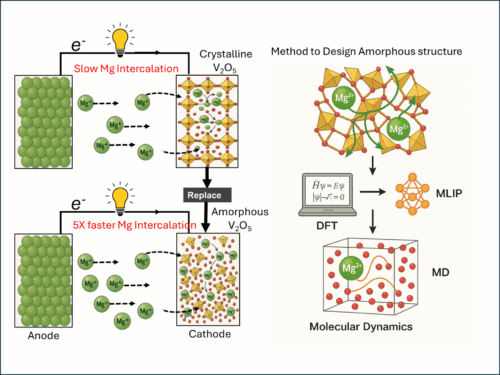
Traditionally, battery cathodes use crystalline materials, where atoms are arranged in a strict pattern. Magnesium moves slowly in these structures, which slows down the battery. To fix this, the team led by Gautam Gopalakrishnan looked at amorphous materials, which have a disordered atomic structure that can act like a sponge, absorbing and releasing magnesium ions more easily.
The researchers created a computational model of an amorphous vanadium pentoxide cathode to see how fast magnesium ions could move inside it. To simulate this efficiently, they combined two methods, density functional theory (DFT), which is accurate but slow, and molecular dynamics (MD), which is faster but less precise. They used machine learning to bridge the gap by training a model on DFT data to run large-scale MD simulations.
The results were striking: magnesium ions moved about 100,000 times faster in the amorphous cathode than in the best crystalline materials. This could dramatically improve energy density and charging speed. The team now hopes experimental researchers will test these materials in real batteries, potentially opening the door to smaller, more powerful batteries for electronics and electric vehicles.