





Quantum processors exchange information via photons, linking modular systems without any physical connection, interconnecting quantum networks.
Connecting two quantum computers is not like connecting servers; quantum systems process information in fragile quantum states that tend to collapse when disturbed. Creating a stable link between them is one of the most complex engineering challenges in modern computing.
Researchers at the University of Oxford have overcome this by connecting two quantum computers using light. The experiment shows that two separate quantum modules can work together as a single system without physical wiring. Instead of sending electrical data, the machines share quantum information through photons, particles of light.
The team uses a method known as quantum gate teleportation to make this connection work. This is the first time a complete quantum algorithm has been executed across two distant modules. The result provides a path for distributed quantum computing, where smaller processors handle parts of a task and exchange data through entangled light signals.
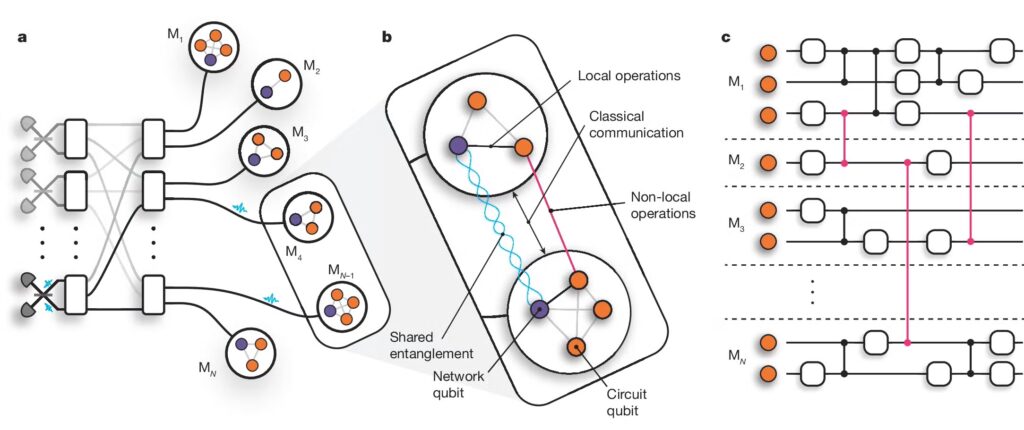
Each module, named Alice and Bob, contains two trapped ions held in vacuum chambers. One ion, made of strontium, acts as a network qubit that communicates via photons. The other, made of calcium, processes and stores quantum data.
When both modules emit photons to a shared optical device, the photons become entangled, linking the two systems. This entanglement enables operations, such as controlled-Z gates, to be teleported between the modules without moving any particles.
The linked machines achieve an 86.2% accuracy in gate operation and nearly 97% in entanglement fidelity. Researchers also run Grover’s search algorithm, proving that complex computations can be performed between separate modules.

