




A precision copper-ion doping method for germanium telluride, pushing its efficiency 50% higher and setting a new benchmark for waste-heat-to-energy conversion.
Queensland University of Technology (QUT) scientists have developed a targeted method of inserting copper ions into germanium telluride, boosting its thermoelectric performance by more than 50%. The new approach enhances the material’s ability to convert waste heat into usable electricity—a key advance for sustainable energy and next-generation electronics.
The team achieved a record figure of merit (a standard measure of thermoelectric efficiency) of 2.3, compared to earlier values of 1.5 for the same material. “That’s a significant improvement in performance, opening a clear pathway for more efficient waste heat recovery technologies,” said Professor Zhi-Gang Chen, who led the study.
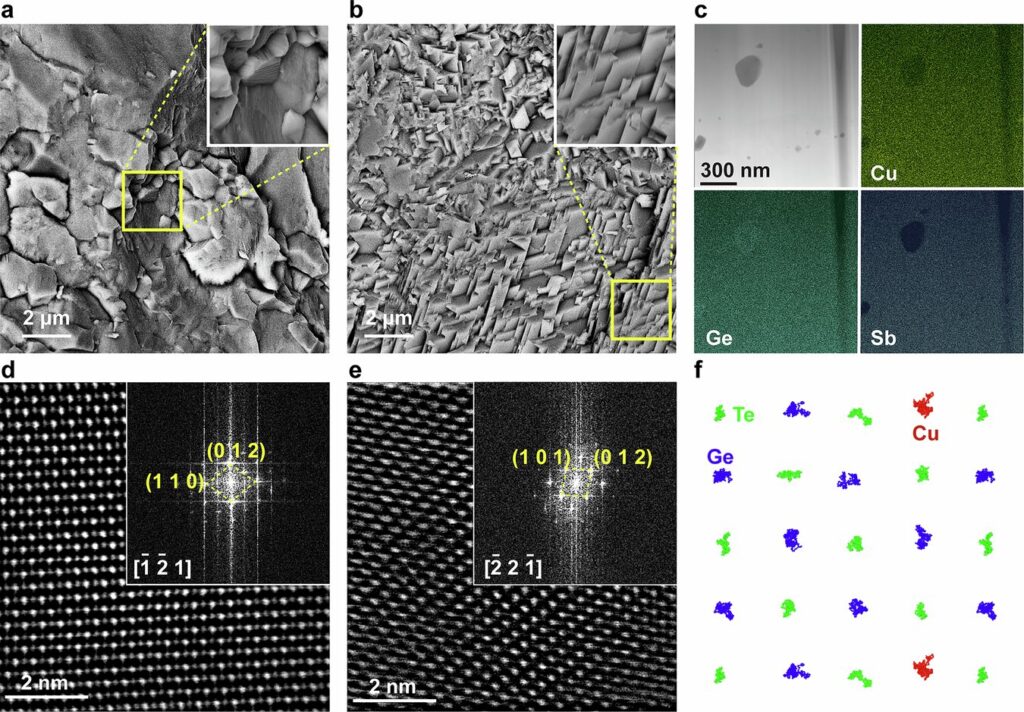
Germanium telluride is widely studied for thermoelectric applications, but atomic flaws in its crystal structure typically limit its efficiency. Traditional “interstitial” copper doping—where ions are wedged between atoms—has yielded only modest gains. In contrast, the QUT team employed a solid solution strategy, guiding copper ions to directly replace specific atoms in the lattice. This precise substitution reduces defects and optimizes the atomic arrangement for energy conversion.
“By attaching copper ions to targeted sites within the crystal, we achieved significantly higher power output than comparable materials,” explained first author Yongqi Chen. “This work provides a blueprint for defect engineering in thermoelectrics.”

Thermoelectric materials, which can directly convert temperature differences into electric current, are being explored for applications ranging from powering microelectronics to harvesting energy from industrial waste heat. The breakthrough could accelerate the deployment of energy-efficient chips, sensors, and other electronics that run partly on recycled heat.
The research was carried out by Yongqi Chen, Professor Chen, Dr. Meng Li, Dr. Xiaodong Wang, and colleagues at QUT. According to the team, the doping strategy could be adapted to improve other thermoelectric compounds as well.
“This technique demonstrates how understanding and correcting atomic-scale flaws can transform a material’s performance,” said Professor Chen. “It’s a step forward not only for germanium telluride but for the broader field of thermoelectrics.”


