

A flexible diving suit lets cyborg cockroaches survive underwater for up to three hours, opening new possibilities for search-and-rescue missions in flooded areas.
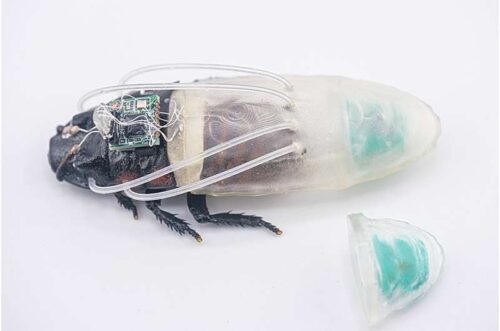
Scientists from NTU Singapore and Waseda University, Japan have developed a flexible diving suit that enables cyborg cockroaches to survive and move underwater and in low-oxygen environments for three hours. This invention can help enhance search-and-rescue efforts in flooded areas during disasters.
The flexible diving suit includes an oxygen-generating tank, a flexible shell and four silicone tubes that transfer oxygen to the cockroach spiracles. An oxygen generator in the form of a 3D-printed case made of PMMA-type resin and containing manganese dioxide that decomposes diluted hydrogen peroxide, releasing oxygen.
During tests on cyborg cockroaches in flooded and low-oxygen environment simulation, they stayed active underwater for up to three hours. The tests were conducted using Madagascar hissing cockroaches, a species usually used in cyborg insect experiments due to their size, resistance and absence of wings.
Professor Hirotaka Sato of NTU Singapore said, “Our new insect diving suit works like the oxygen tank used by human divers. It generates oxygen and delivers it directly to the insect’s breathing holes, allowing the cyborg cockroach to survive and move in underwater or low-oxygen environments.”
The researchers think that this technique can also be used for inspecting flooded pipes, drains and tunnels, and hard to reach infrastructure and may in future be extended for use with other terrestrial cyborg insects like locusts and beetles. Future work will focus on improving the suit’s durability and integrating sensors and navigation systems.