




Storage is slowing down modern devices. A memory design offers more space and faster data access while keeping size and power use low.
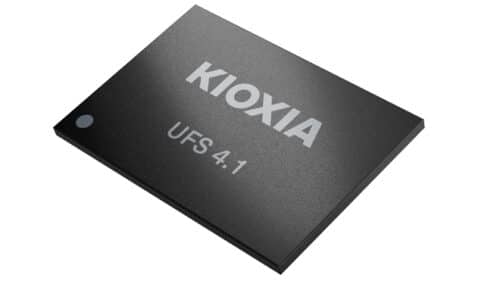
As smartphones, tablets, and connected devices handle larger apps, higher-resolution media, and on-device AI, storage capacity and speed are becoming major bottlenecks. Many existing memory solutions struggle to deliver both high capacity and fast performance within tight space and power limits. To address this, Kioxia has developed a new UFS 4.1 embedded memory based on QLC technology, aimed at devices that need more storage without losing speed.
The new memory improves performance in read-heavy workloads common in mobile, AI, and connected systems. Compared to the previous generation, it delivers 25% faster sequential write speeds, 90% higher random read speeds, and 95% faster random write speeds. It also improves write efficiency by up to 3.5 times when WriteBooster is disabled, helping reduce unnecessary data movement and extend device lifespan.
Higher bit density allows much larger storage in the same physical space, making it suitable for smartphones and tablets that need to store high-resolution video, large apps, and AI models. The performance and capacity gains also support PCs, networking equipment, AR/VR systems, IoT devices, and AI-enabled hardware, where fast and reliable local storage is critical.
Some of the key features of the UFS 4.1 embedded memory
- Compliant with the UFS 4.1 specification.
- UFS 4.1 is backward-compatible with UFS 4.0 and UFS 3.1.
- 8th generation Kioxia BiCS FLASH™ 3D flash memory
- WriteBooster support for significantly faster write speeds
- Reduced package size compared to the previous QLC UFS: 11×13 mm to 9×13 mm
These gains come from Kioxia’s 8th-generation BiCS FLASH 3D memory, combined with advanced controller design and improved error correction. The use of CMOS directly bonded to the memory array improves speed, density, and power efficiency. The devices integrate memory and controller in a standard package and are available in 512 GB and 1 TB capacities, enabling compact designs while meeting rising storage demands.


