The study shows how moving protons in water-based batteries can make them safer, faster to charge, and able to store more energy.
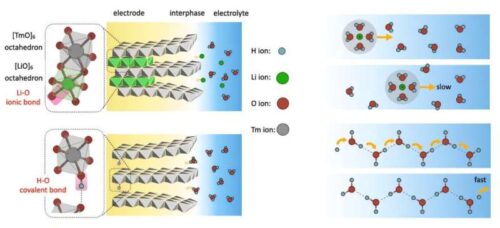
Researchers at Peking University Shenzhen Graduate School have discovered how to improve the performance of aqueous batteries by controlling how protons are stored and transported. The study focuses on hydrogen-bond network engineering to enhance proton transport—key to making aqueous batteries more practical. Unlike lithium-ion systems, aqueous batteries use water-based electrolytes, making them naturally safer. However, their lower energy density has been a major limitation. Protons are suitable for charge carriers because of their light weight and high mobility, but their complex chemistry has made them difficult to use effectively.
The team found that protons move through a Grotthuss-type mechanism—hopping between hydrogen bonds rather than diffusing slowly like metal ions. This “diffusion-free” movement enables much faster charge transport, a major advantage for battery performance.
To further improve these systems, the researchers propose three strategies using hydrogen-bond network engineering:
- Electrode design: Embedding water-containing or anhydrous hydrogen-bond networks into solid-state materials to create defined proton pathways.
- Electrolyte tuning: Adjusting acid concentration and selecting specific anions to stabilize and enhance proton conductivity.
- Interface engineering: Modifying electrode surfaces—such as introducing hydroxyl (–OH) and carboxyl (–COOH) groups via oxygen plasma—to form proton-bridging channels that reduce charge-transfer resistance and speed up reactions.
These strategies together form a clear framework for understanding and improving how protons behave in aqueous systems.
Protons differ fundamentally from lithium and sodium ions. While Li⁺ and Na⁺ form rigid ionic bonds in crystal lattices, H⁺ forms covalent H–O bonds that don’t integrate into such frameworks. This difference requires a different design approach—but also opens up new possibilities.
By addressing this challenge, the study lays the groundwork for a new generation of proton-based aqueous batteries. These batteries could combine the safety of water-based systems with the performance needed for large-scale storage, portable electronics, and electric vehicles.