




What if six motors could run from a single controller? This reference design shows an approach for robotic hands and multi-axis motion systems.
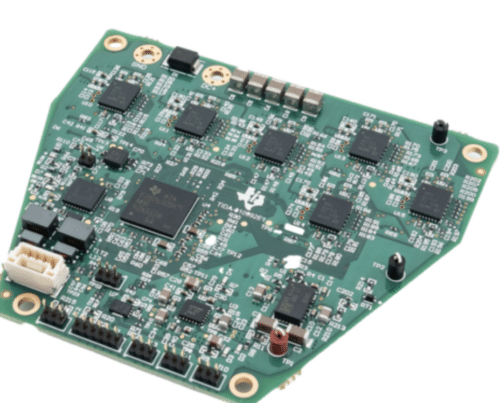
Humanoid robots require many small motors to control fingers and joints, making motor control one of the key design challenges for engineers. A reference design from Texas Instruments (TI) addresses this challenge by demonstrating how a single controller can manage six motors at the same time, helping engineers reduce board space, component count, and system complexity in robotic hand applications.
TIDA-010992 is intended for multi-axis motor control in compact robotic systems. Instead of assigning a separate controller to each motor, it uses one controller to handle six independent brushless DC motors. This approach allows engineers to build more compact robotic hands while simplifying hardware architecture.
One of the main advantages of the design is its ability to support six-axis field-oriented control (FOC). Engineers can use the platform to implement current, speed, and position control for multiple motors simultaneously. This makes it suitable for applications such as robotic fingers, grippers, dexterous hands, and other systems that require coordinated movement across several joints.
The design uses integrated motor drivers that combine gate drivers, MOSFETs, and current sensing functions in a single device. This reduces the number of external components required on the board and helps engineers create smaller motor control systems while maintaining accurate motor control performance.
The platform supports motors operating from 12V and 24V power supplies and can drive motors rated up to 80W. Engineers developing robotic hands can use the design to evaluate motor performance, optimize control algorithms, and test multi-axis motion control before moving to production hardware.
A key feature of the design is its compact implementation. The six-axis motor control circuitry occupies less than 420 mm² of board space. For robotic systems where electronics must fit inside limited mechanical structures, such as fingers or palms, this reduction in size can simplify system integration and allow more room for sensors, batteries, or communication modules.
The design also provides multiple communication options. Engineers can connect the motor control system to higher-level robot controllers through interfaces such as CAN-FD, UART, Fast Serial Interface (FSI), and EtherCAT. These interfaces make it easier to integrate the design into larger robotic platforms where motion control, sensing, and decision-making systems must work together.
Software support is included for multi-axis motor control, enabling engineers to evaluate and develop control algorithms without building the entire software framework from the ground up. The reference design can be used as a starting point for testing synchronized motion, position control, and coordinated finger movement in robotic hands.
Beyond robotic hands, the architecture can also be adapted for other compact multi-motor systems that require precise control and limited board space. Examples include robotic grippers, small industrial robots, service robots, and automated mechanisms with multiple motion axes.
TI has tested this reference design. It comes with a bill of materials (BOM), schematics, assembly drawing, printed circuit board (PCB) layout, and more. The company’s website has additional data about the reference design. To read more about this reference design, click here.
