




A new automotive-grade gate driver simplifies power-switching design by embedding an adjustable negative bias, eliminating external circuitry and boosting reliability in high-efficiency SiC and IGBT systems for EVs and industrial power platforms.
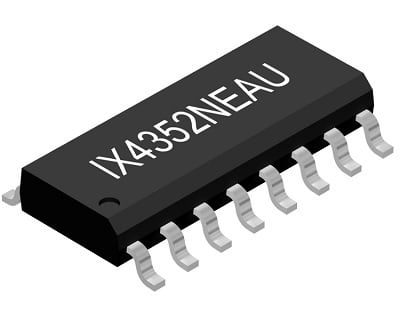
Littelfuse has introduced a new automotive-qualified low-side gate driver IC, the IX4352NEAU, targeting modern high-performance power-switching applications in EVs, DC-DC converters and drivetrains. It represents a major step in driver integration by embedding an adjustable negative gate-drive bias—down to –10 V—for the first time in an AEC-Q100-qualified device of this class.
The key features are:
- Supports 9 A peak source and sink currents on separate pins for precise switching control.
- Enables fine-tuned turn-on/off timing, improving efficiency and minimizing switching losses.
- Features 3.3 V TTL/CMOS-compatible inputs with up to 7 V tolerance.
- AEC-Q100 qualified for operation in temperature- and reliability-critical environments.
- Ideal for EV traction inverters, motor drives, and onboard DC-DC converters.
It has the onboard negative bias generator, eliminating the need for an external negative rail or costly converter to suppress parasitic turn-on in fast devices such as SiC MOSFETs and IGBTs. By integrating this capability, developers can reduce component count, shrink board real‐estate and raise system power density. It also hosts protection features such as DESAT detection, active soft shutdown, undervoltage lock-out (UVLO), thermal shutdown (TSD) and a fault-output pin, enhancing robustness in demanding automotive environments.
By embedding the negative bias capability, Littelfuse claims the device delivers “safer, more compact, and more efficient power systems,” while accelerating time-to-market and reducing total system cost. It offers an integrated, performance-rich driver solution for next-generation automotive power electronics systems.


