What if light could do more than move tiny objects? A gripper uses light to pick up, move, and place small parts that other light-based tools cannot easily handle.
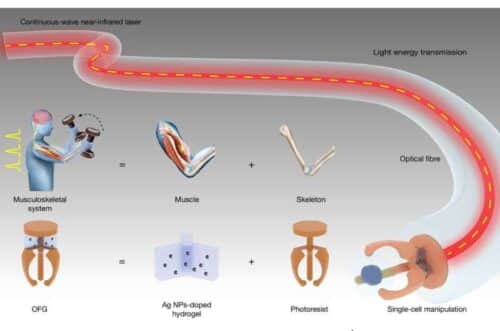
Researchers from Anhui University have developed a light-controlled microgripper that combines the precision of optical tweezers with the stronger holding force of mechanical grippers. The device enables the manipulation of microscopic objects that are difficult to handle using conventional light-based techniques.
The microgripper is built directly onto the tip of a standard optical fiber and measures just 38 × 38 × 61 micrometers. The team fabricated the structure using two-photon polymerization, a 3D-printing method designed for microscopic structures.
Optical tweezers use tightly focused laser beams to trap and move tiny objects without physical contact. While highly precise, they generate only very small forces, making them less effective for manipulating heavier, opaque, or irregularly shaped materials.
To overcome this limitation, the researchers designed a bio-inspired optical fiber gripper. The optical fiber carries light signals, a hydrogel containing silver nanoparticles functions as an artificial muscle, and polymer claws provide the gripping structure. When near-infrared light travels through the fiber and reaches the nanoparticles, the hydrogel contracts and opens the claws. Turning off the light allows the claws to close and grip an object.

In testing, the gripper responded within 77 milliseconds and operated at up to five cycles per second. It generated forces in the micronewton range, more than ten times greater than those achieved by previous fiber-based optical tweezers.
The device successfully handled a range of materials, including alumina spheres, silicon carbide fragments, and copper wires measuring up to 20 centimeters in length. It also grasped, transported, and released individual human cancer cells without damaging them.
The team further demonstrated the gripper’s ability to assemble miniature mechanical components such as bearings and gearboxes with micrometer-level precision. Its compact size also allows it to access spaces narrower than 300 micrometers and operate within biological tissue samples.
According to the researchers, the technology could support future applications in single-cell studies, minimally invasive medical procedures, and the assembly of microscale machines.