

Researchers at the University of Illinois Urbana-Champaign have unveiled a high-fidelity modular architecture for superconducting quantum processors, achieving ~99% SWAP gate fidelity.
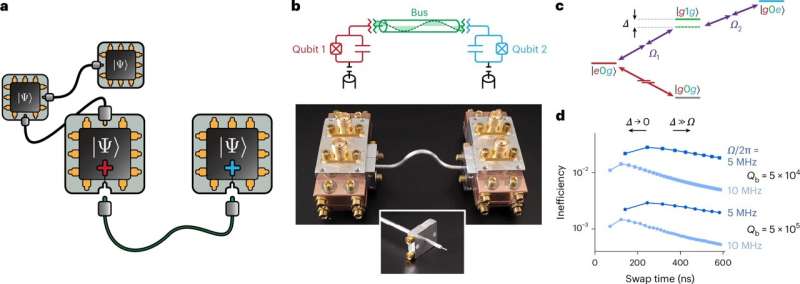
Researchers at The Grainger College of Engineering, University of Illinois Urbana-Champaign, have demonstrated a modular architecture for superconducting quantum processors—paving the way toward scalable and fault-tolerant quantum systems. Their work addresses a critical challenge in the quantum race: how to scale quantum computers beyond limited monolithic architectures. Just as children’s Lego bricks snap together to form complex creations, this modular strategy enables quantum components to be individually built, tested, and then interconnected—dramatically boosting flexibility and performance.
The team connected two superconducting qubit modules using specially designed coaxial cables, achieving an impressive ~99% SWAP gate fidelity—a measure of how accurately quantum states can be exchanged between modules. This represents less than 1% operational error, a major milestone in demonstrating reliable qubit interconnects.
Beyond performance, modularity opens new doors in system design. The team mentioned that one don’t want to find errors only after assembling the whole machine. With modularity, they can build, test, and then combine or replace parts—just like debugging a circuit board or swapping a server node. The team’s success comes after years of trial and error across the quantum field. Many had theorized about modular systems, but lacked the right integration tools. They claim that what they’ve shown is that high-fidelity communication through physical connectors is not just possible—it’s practical.
Next, the researchers plan to expand beyond two devices, pushing modular quantum architectures toward even larger networks—without compromising reconfigurability or performance. “We have the building blocks,Now it’s time to see how far we can stack them,Modularity gives us scalability, upgrade paths, and better fault isolation,” said Dr. Wolfgang Pfaff, senior author and assistant professor of physics. Instead of one fragile monolith, they can now construct systems from smaller, high-fidelity units—and reconfigure them when needed.