From lab to workplace, these humanoid robots built for industrial precision are now ready to perform real tasks at scale.
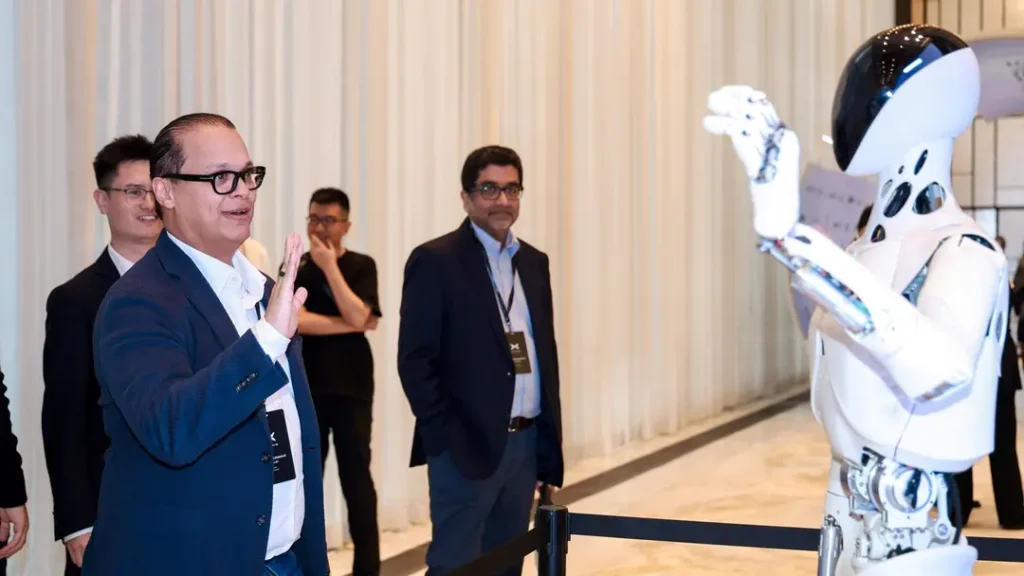
Humanoid robots have long promised to extend AI into physical environments, but progress has been constrained by challenges around reliability, manufacturability, and real world deployment. Many prototypes remain confined to labs or demos, lacking the automotive grade engineering and production discipline required for scalable, commercial use. As demand grows for embodied AI systems in factories, retail, and service environments, the ability to industrialize humanoid robotics has become a critical hurdle.
XPeng is addressing this challenge with the rollout of its first ET1 humanoid robot prototype, developed to automotive grade standards and produced on a manufacturing line. Founder and CEO He Xiaopeng confirmed that the first unit has successfully rolled off the production line, marking a key step toward large scale production.
The company previously unveiled its IRON humanoid robot featuring over 60 joints and more than 200 degrees of freedom, followed by a second generation model powered by its VLA 2.0 AI system and in house chips delivering trillions of operations per second. XPeng says its humanoid robots already share core technologies with its electric vehicles and are being tested internally for commercial service roles such as factories and retail spaces.
Key features of the robots include:
- Second generation humanoid architecture powered by VLA 2.0 AI model
- In house AI chips delivering multi trillion operations per second
- Humanoid structure with advanced spine design, bionic muscles and flexible synthetic skin
- More than 60 joints and approximately 200 degrees of freedom for human like motion
- Shared AI and hardware stack with XPeng electric vehicles
- Designed for multiple service applications including factories and hospitality
He Xiaopeng, founder and CEO of XPeng, says, “This marks a critical step toward large scale production of advanced humanoid robots. Our goal is to bring humanoid robotics from concept to real world deployment.”