





Scientists generate both even and odd terahertz light frequencies, opening new paths for high-speed communication, imaging, and quantum computing.
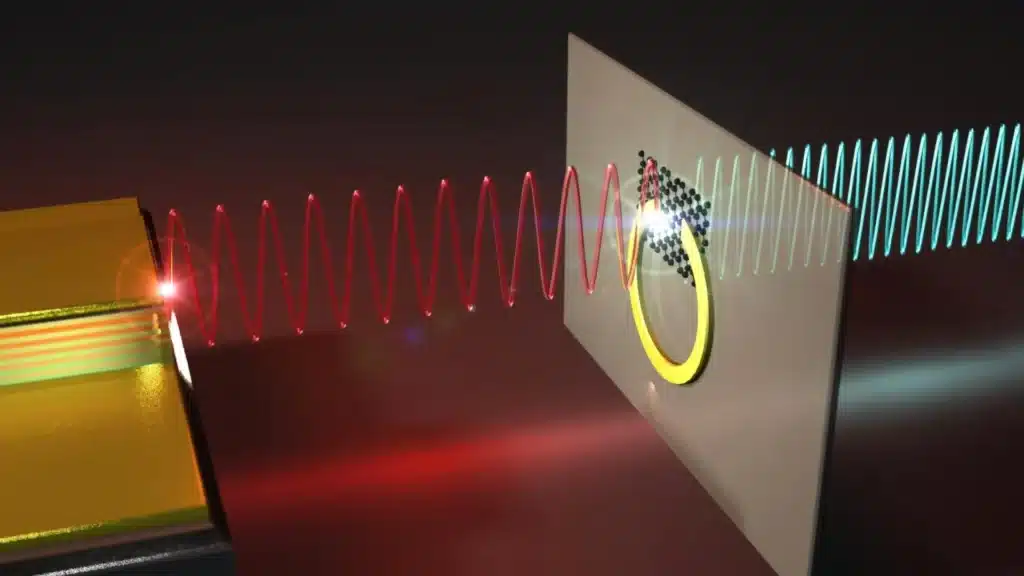
Generating light at terahertz frequencies has remained a challenge because most materials cannot efficiently convert light into this range. Terahertz waves sit between microwave and infrared light on the electromagnetic spectrum.
They are important because they can carry vast amounts of data, penetrate materials without damage, and operate at extremely high speeds. These properties make them valuable for future wireless communication, medical imaging, security scanning, and quantum computing.
However, producing terahertz light in a stable and controllable way has been difficult due to the limitations of existing materials.
To address this, scientists have turned to topological insulators. It’s a type of quantum material that behaves as an insulator inside but conducts electricity along its surface.
A study published in Light: Science & Applications demonstrates that these materials can generate both even and odd terahertz frequencies of light, something not achieved before. This result helps overcome one of the biggest barriers in terahertz light generation.
A team led by Professor Miriam Serena Vitiello uses a process called high-order harmonic generation (HHG), which converts light into higher frequencies. Most materials used for HHG are too symmetrical, meaning they can only produce odd harmonics, or odd multiples of the incoming light’s frequency.
To make even harmonics as well, the material needs an asymmetric structure. Topological insulators naturally have this asymmetry due to their unique surface behaviour driven by quantum spin–orbit coupling, where the spin and motion of electrons are connected.
The team integrated thin layers of bismuth selenide (Bi₂Se₃) and (InₓBi₁₋ₓ)₂Se₃ into nanostructures called split ring resonators, which amplify light at the nanoscale. This setup allows them to observe light conversion between 6.4 terahertz (even) and 9.7 terahertz (odd). The findings confirm that both surface and internal symmetry of these materials influence how terahertz light is generated.
The study demonstrates how quantum materials can be engineered to produce controllable terahertz frequencies, paving the way for faster data transfer, compact sensors, and energy-efficient quantum and optical devices.

