The system logs the data of size, speed, and composition of debris, enabling early warnings and improving risk awareness in low-Earth orbit.
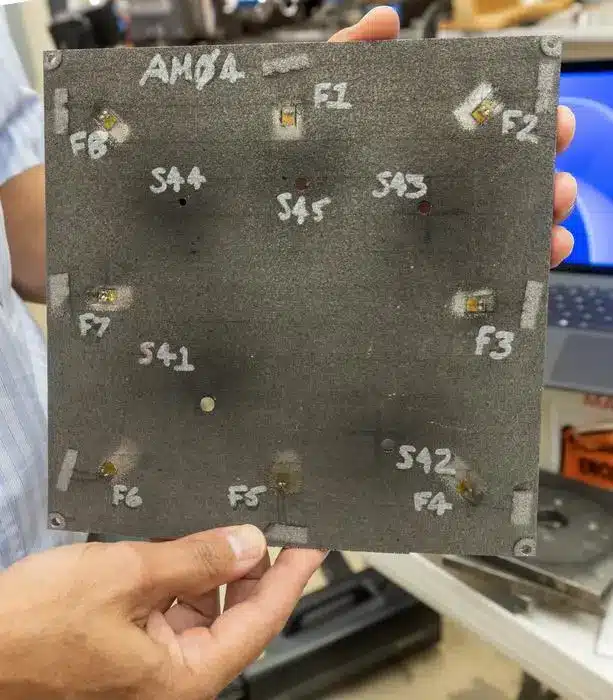
Engineers at Southwest Research Institute (SwRI) have built a hardware system capable of detecting micrometeoroid and orbital debris (MMOD) impacts on satellites. The system integrates sensor arrays into structural panels, enabling real-time detection and data acquisition of high-velocity impact events.
While most tracked debris in low-earth orbitals are larger than 10 cm, the majority of untracked MMOD ranges between 1 mm and a few centimetres, small enough to go unnoticed but fast enough to cause significant damage at orbital speeds reaching 28,000 km/h.
The device is designed, integrating the sensors into satellite chassis or as an external module. It consists of a composite sensing panel layered with impact detection elements.
When a high-speed object strikes the satellites, the embedded electronics sensors capture mechanical impact signatures. The impact data is processed to extract important parameters like the event timestamp, location, and object characteristics such as size, velocity, and composition.
Signal analysis is performed by onboard firmware, which then transmits compressed data to ground systems for post-processing and archival. The system operates independently of visible damage, offering data even when collisions leave no external trace.
Testing was conducted under controlled conditions using a light gas gun to fire projectiles at the sensor panels in vacuum environments. These simulations were designed to approximate orbital collision dynamics at typical low-Earth orbit velocities.
The electronics maintained signal integrity under impact and delivered reliable data on fragment mass and kinetic profile. The system may be used to assess cumulative material fatigue on exposed structures or inform dynamic shielding responses in real time.
SwRI proposes distributed deployment across satellite constellations to support networked impact reporting. Such data can feed into collision-avoidance algorithms, potentially triggering reorientation or manoeuvre commands.
The system also contributes to in-situ characterisation of orbital debris. Unlike radar-based ground tracking, this hardware directly measures micro-collisions, offering physical data from impacted nodes.