A unified MCU architecture brings multiple interfaces into a single device, supporting a scalable, secure and over-the-air update-capable design.
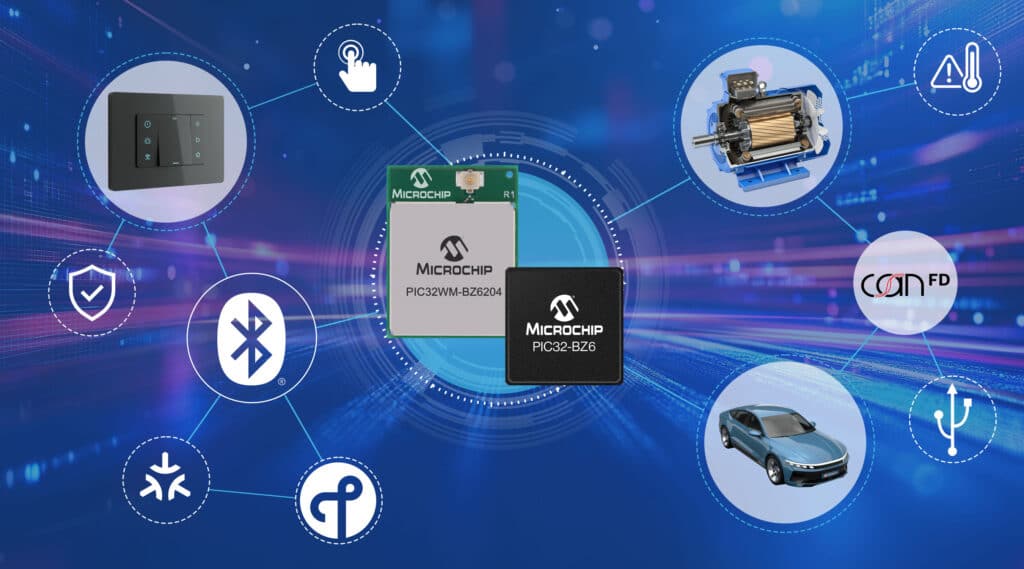
As wireless technology evolves, manufacturers face the challenge of redesigning products to support the latest connectivity protocols, increasing both cost and development time. Microchip Technology addresses this issue by introducing the PIC32-BZ6 microcontroller unit, a single-chip platform designed to handle multiple protocols in one device.
The MCU integrated Bluetooth Low Energy, Thread, Matter and proprietary protocols on the same chip, enabling developers to build products that can adapt to changing connectivity requirements without hardware modification. It replaces traditional multi-chip systems used for wireless connectivity, touch sensing and motor control, reducing design complexity and improving efficiency.
The PIC32-BZ6 includes 2 MB Flash memory and 512 KB of RAM, supporting larger applications and over-the-air firmware updates. It is available in a 132-pin package, with more variants to meet different performance and size. The device supports Bluetooth 6 and 802.15.4-based protocols, allowing interoperability across connected devices in industries and automotive environments.
To support wired communication, the MCU integrates two CAN-FD ports, a 10/100 Mbps Ethernet MAC and USB 2.0. It also incorporates touch and graphics drivers.
For motion-based applications, the chip included 12-bit ADCs, a 7-bit DAC, comparators, pulse width modules (PWM) and a Quadrature Encoder Interface (QEI) to support motor control systems.
It comes with security embedded in the hardware, with secure boot and AES, SHA, ECC and TRNG encryption to protect firmware and intellectual property. It meets the AEC-Q100 Grade 1 qualification, supporting operation up to 125°C for use in industrial and automotive environments.
Microchip supports the MCU with its MPLAB Integrated Development Environment (IDE), Zephyr Real-Time Operating System (RTOS) and the PIC32-BZ6 Curiosity Board. The SoC is priced at US$3.73, and the RF-certified module at US$5.84 in 10,000-unit quantities.