

Built on lithium niobate, the breakthrough delivers speeds up to 186 Gbps while slashing energy use—paving the way for faster AI computing, efficient data centers, and next-gen 5G/6G communications.
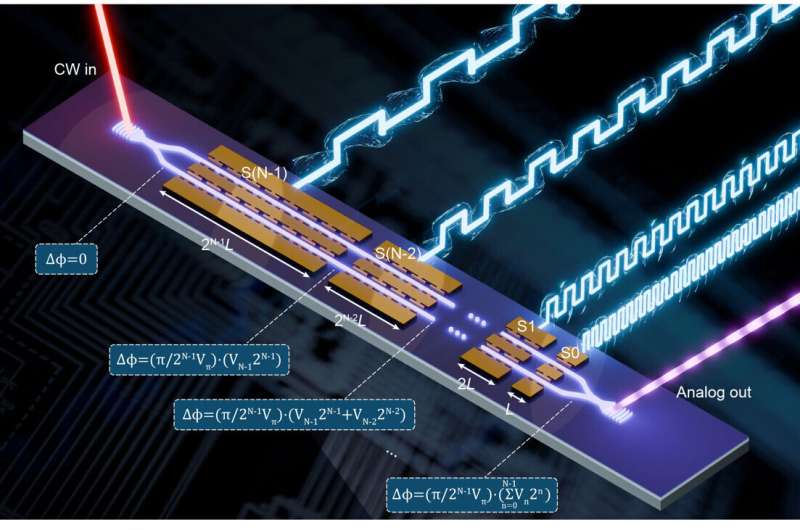
Researchers at Harvard John A. Paulson School of Engineering and Applied Sciences (SEAS) have unveiled a device that can directly convert digital electronic signals into analog optical signals, eliminating the need for today’s energy-hungry digital-to-analog converters and modulators. Published in Nature Photonics, the innovation could transform fiber-optic networks, data centers, and wireless communications by streamlining one of the most critical yet inefficient steps in data transfer.
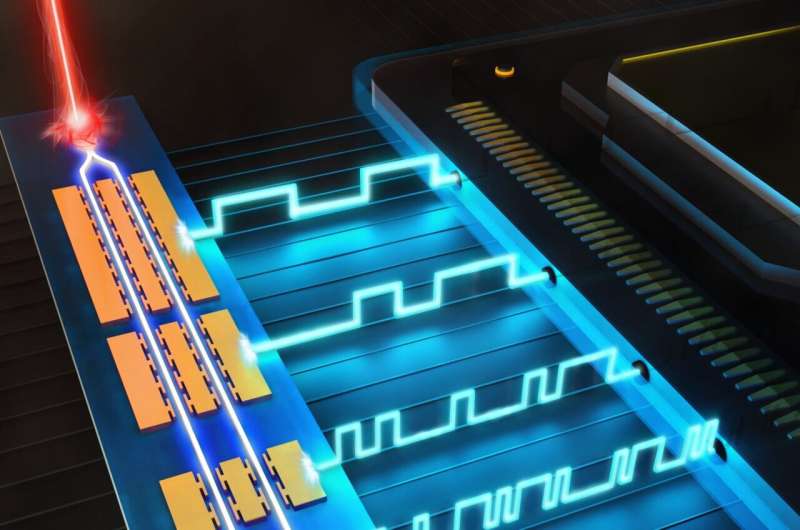
The new device, called the electro-optic digital-to-analog link (EO-DiAL), is built on thin-film lithium niobate, a proven material in optoelectronics. Unlike conventional systems that rely on separate electronic conversion stages, EO-DiAL performs the entire process in one smooth step. It can operate at information rates of up to 186 gigabits per second—close to 100 times faster than average home internet speeds. By collapsing the conversion process into a single chip-based component, EO-DiAL promises reduced power consumption, smaller system footprints, and higher overall efficiency in data networks. “For photonic technologies to seamlessly integrate with electronic ones, the interfaces must be fast and energy-efficient,” said senior author Marko Lončar, Tiantsai Lin Professor of Electrical Engineering at SEAS.
This efficiency advantage has broad implications. Photonic systems are increasingly central to artificial intelligence computing, data center interconnects, and microwave photonics. The Harvard device could enable faster and more efficient AI model training, accelerate optical computing platforms, and even generate high-frequency radio signals for advanced radar and 5G/6G wireless networks. As co-first author Yaowen Hu, now at Peking University, explained, the work addresses a longstanding bottleneck in computing and interconnects that limits the potential of photonic technologies.
To validate performance, the team demonstrated the device by optically encoding images from the widely used MNIST dataset, showing both precision and high-speed capability. Importantly, EO-DiAL was fabricated using a lithium niobate foundry process developed by Harvard startup HyperLight Corporation. This process mirrors silicon chip manufacturing, making the new device scalable and cost-effective for mass production. By combining technical performance with manufacturability, Harvard’s breakthrough represents a significant step toward seamless electronic-photonic integration and could redefine how data is processed and transmitted in future computing and communication systems.