




The technology combines real-time compensation and digital lithography to improve the manufacturing of next-generation flexible electronics.
Dr Won Seok Chang, Director of Nano-convergence Manufacturing Research Division at Korea Institute of Machinery and Materials (KIMM), and his research team have developed a digital lithography scanner that compensates for substrate deformation and positional errors in real-time during the roll-to-roll (R2R) process.
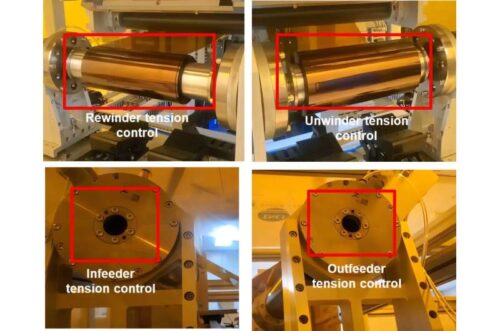
The R2R digital lithography device features maskless digital lithography with a continuous R2R process and can be used for the mass-production of next-generation flexible electronic devices. The R2R digital lithography device uses DMD-based digital exposure technology in which UV light is directed to certain parts of the flexible substrate. Moreover, researchers have designed an exposure module and an ultra-precise web transport system which is capable of achieving line widths of less than 10 µm.
While traditional lithographic systems operate using scanning stages and usually need flexible substrates to be mounted to a carrier substrate, the new approach uses line-beam exposure to continuously create patterns on moving substrates passing over a rotating roller. This technology makes it possible to eliminate the use of traditional photomasks and allows patterns to be generated and modified through software control.
According to the researchers, the technology is expected to improve productivity in the production of flexible printed circuit boards, high-resolution flexible electronics, and semiconductor packaging. The technology was named a finalist for the “Technology of the Year” award in 2026 R2R U.S. Conference & Expo due to high-resolution patterning and real-time compensation of substrate deformation.
The technology has been developed through the institute research project of KIMM entitled “Development of Core Technologies for Real Time Compensation Based Roll to Roll Patterning System.” The research team has published 25 papers and filed nine international and 12 domestic patents. To date, one patent arising from the international filings and 12 domestic patents have been granted.

