

This shows how robots could learn complex, human-like skills from a single demonstration—opening doors to safer, more adaptable helpers in homes, warehouses, and care settings.
Robots may land spacecraft on Mars or perform delicate surgeries, but give them a bulky box and they still falter. That limitation may be changing. Researchers at the Toyota Research Institute in Massachusetts have taught a humanoid robot, Punyo, to maneuver large, unwieldy objects in a human-like way—after just a single lesson.
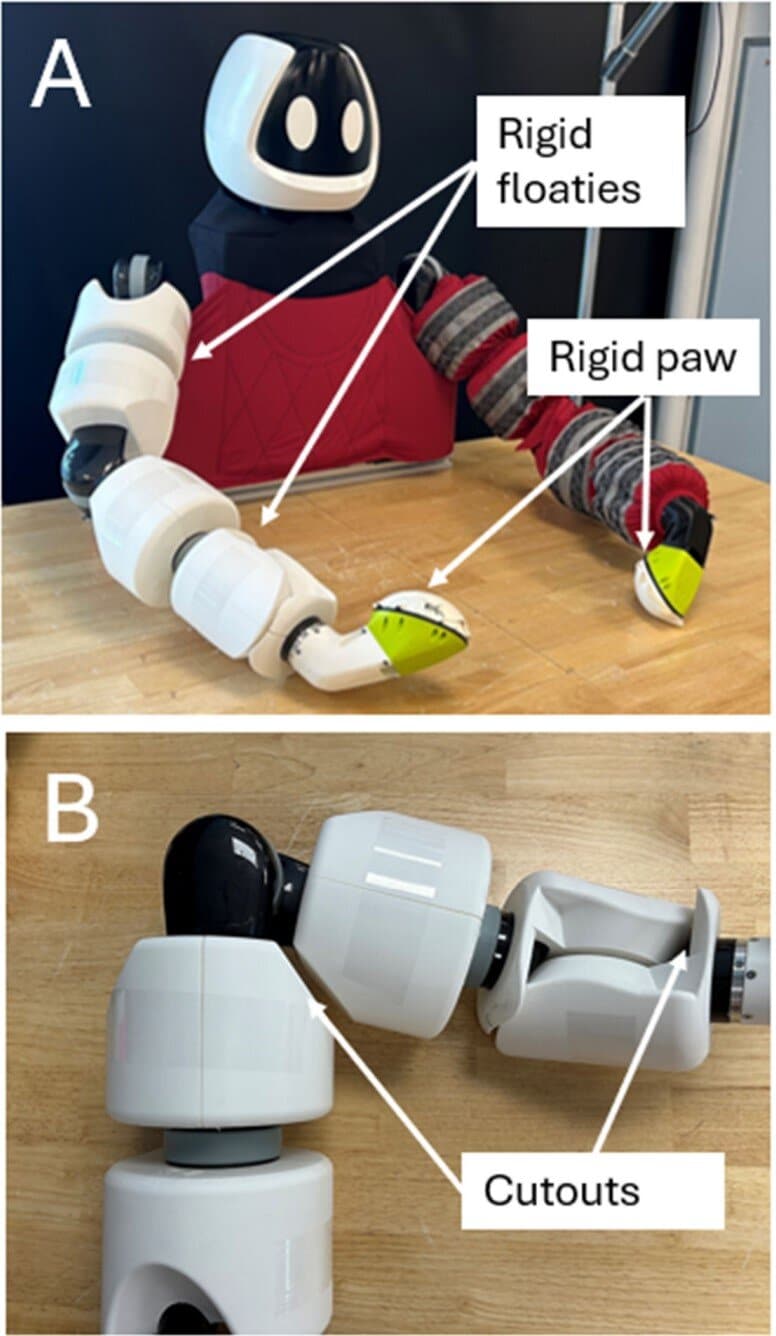
In experiments reported in Science Robotics, Punyo hoisted a heavy water jug onto its shoulder and pivoted a large box without dropping it. Instead of relying solely on rigid arms or pre-programmed paths, the robot used a combination of tactile sensors in its soft “skin” and feedback from its joints to constantly adjust its grip and stance. The approach allowed it to perform tasks that usually overwhelm robotic systems requiring high precision.
The advancement hinges on “compliance”—a mix of passive softness in the robot’s body and active flexibility programmed into its joints. Compared to a rigid model, Punyo’s success rate improved by more than 200%. The robot effectively distributed the weight of large objects across its whole body, mimicking how humans instinctively use arms, shoulders, and torso to balance a load.
Even more striking is how little training it needed. Using “example-guided reinforcement learning,” researchers gave Punyo a single teleoperated demonstration inside a virtual environment. From that lone example, the robot refined its own motions through trial and error until it could repeat them smoothly in real-world tests.
The ability to learn fast from minimal input could make robots far more adaptable outside the lab. Instead of requiring complex programming for every new task, a single human demonstration could be enough for robots to assist in homes, warehouses, or healthcare settings. That means safely moving furniture, handling heavy packages, or supporting people with limited mobility.
While Punyo is still a research prototype, the work points to a future where robots can finally handle the kind of everyday physical challenges humans perform without thinking. By combining tactile awareness with human-like gross motor skills, machines may soon be just as useful lifting boxes as they are operating in surgical theaters.