Learn how robots now support inspection patrol and logistics across large unstructured sites without constant human supervision.
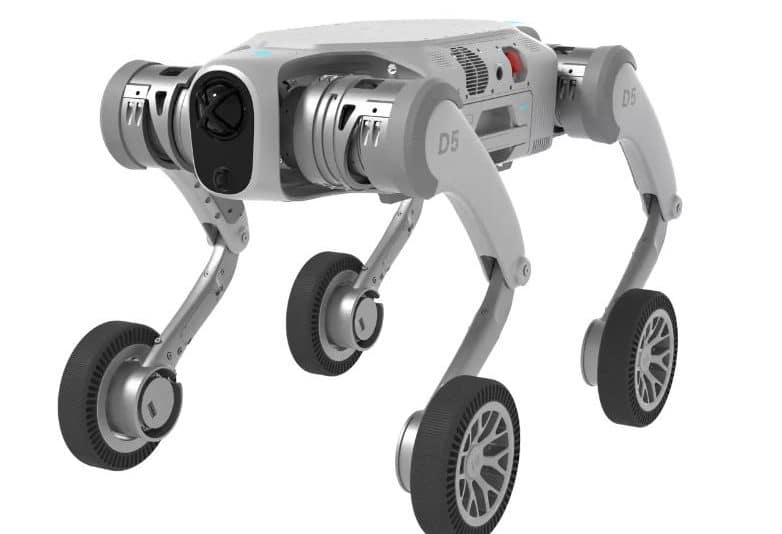
Automation in outdoor and industrial environments remains limited due to uneven terrain, stairs, weather exposure, and large unstructured layouts. Conventional service robots are typically designed for controlled indoor spaces, leaving inspection, patrol, logistics support, and emergency response in complex environments dependent on manual operations.
Addressing this gap, Pudu Robotics has introduced the PUDU D5 Series, a set of industry grade autonomous quadruped robots designed for real world outdoor and large scale industrial use. The series includes two variants: a legged configuration focused on terrain adaptability and a wheeled configuration optimized for mixed surface operation. The systems are intended for deployment in applications such as infrastructure inspection, campus patrol, transportation facilities, and industrial sites.
The robots are built around an onboard autonomous computing architecture capable of running perception, navigation, and decision making processes in real time. A combination of vision sensors and LiDAR enables continuous mapping, localization, and obstacle handling without direct supervision. The platform is designed to operate across large areas and maintain stability while carrying mission specific payloads.
Key features include:
- Dual processor onboard computing supporting real time autonomous navigation and perception
- Multi sensor 360 degree environment sensing using cameras and LiDAR
- Capability to map and navigate facilities up to one million square meters
- Support for payloads up to 30 kilograms with stable motion control
- Mobility across slopes, stairs, and uneven ground
- Operation across a wide temperature range with dust and water resistance
- Gesture and voice based interaction for on site operation
Felix Zhang, Founder and Chief Executive Officer of Pudu Robotics says, “Outdoor and industrial environments require robots that can adapt to real world conditions rather than controlled spaces.” This highlights the use of autonomous robotic systems beyond structured indoor settings, enabling deployment in environments where mobility, perception and durability are critical to sustained operation.