




A robot can walk better, stay balanced, and learn for longer without falling. Its smart design makes humanoid robots stronger, faster, and safer.
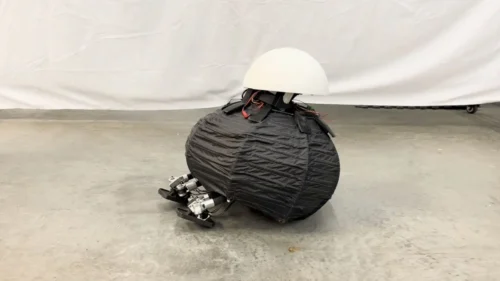
Humanoid robots often struggle with agile, stable, and efficient walking in real-world settings because traditional designs are heavy at the limbs, slow, and fragile when falling. US researchers have addressed this with the HybridLeg platform, a bipedal robot that combines mechanical efficiency with biological familiarity to enable long-duration reinforcement learning experiments safely and reliably.
The platform is designed for researchers and engineers running real-world robotics experiments who need robots capable of extended autonomous operation, accurate physics modeling, and robust fall management. A lantern-shaped, sensor-equipped cover protects the robot during full-body contact, while multimodal fall detection and improved stance-phase tracking prevent damage during trials.
Unlike conventional humanoids that mimic human anatomy using purely serial linkages, HybridLeg blends serial and parallel linkages. This creates a lightweight, fast-moving leg with low inertia and high payload capacity, enabling accurate simulations of walking dynamics using simplified models such as the linear inverted pendulum. Each leg forms a five-bar closed linkage powered by 12 motors, with 10 near the pelvis and only 2 at the ankles, minimizing swing-leg mass and improving movement precision.
The robot is fully untethered, integrating a single-board computer, IMU, voltage converter, and LiPo batteries within its body. Its structure uses carbon fiber tubes and high-precision bearings for rigidity and accuracy while supporting its own weight. A custom pelvis inspired by human biomechanics provides a yaw offset similar to the human toe-out angle, which expands foot reach and improves balance.
Standing 1.84 meters tall yet weighing only 29 kilograms, the HybridLeg biped achieves agile, high-payload walking using standard servo motors, showing that the hybrid design delivers efficiency without oversized actuators. Simulations of workspace and velocity closely match hardware experiments, including squatting, in-place walking, and basic forward locomotion, validating the approach for real-world applications.
The HybridLeg platform solves key problems in bipedal robotics: it allows safer experimentation, enables robust long-term learning, reduces limb inertia, and improves dynamic performance. This makes it a scalable and practical foundation for advancing humanoid locomotion research and real-world robotic applications.
