




New manufacturing platforms address high-aspect-ratio etching, advanced memory deposition, metal films, and silicon-carbide epitaxy for next-generation semiconductor production.
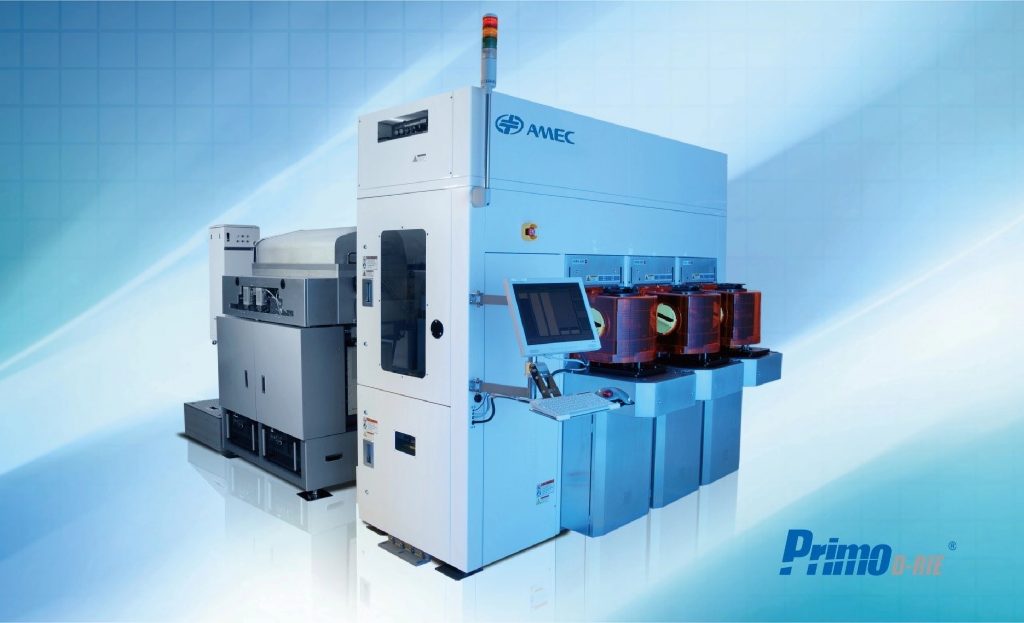
Semiconductor equipment maker AMEC (Advanced Micro-Fabrication Equipment Inc. China) introduced six new high-end semiconductor manufacturing systems covering etching, thin-film deposition and silicon-carbide epitaxy. The portfolio is aimed at demanding processes in 3D NAND, DRAM, advanced logic and power semiconductor manufacturing.
The most notable launch is the Primo XD-RIE, an extreme high-aspect-ratio etching system developed for advanced memory structures. It supports aspect ratios from 70:1 to 90:1, addressing the increasingly deep and narrow channels required as 3D NAND and DRAM architectures gain more layers. The system combines a high-frequency RF power architecture, adjustable high-power DC bias and low-temperature etching technologies to improve etch precision and efficiency.
The key features are:
- 70:1–90:1 extreme high-aspect-ratio etching
- Four-chamber PECVD architecture
- 16-wafer simultaneous processing capability
- 12-inch molybdenum ALD processing
- Four 8-inch SiC epitaxy wafers processed simultaneously
The system also uses a low-temperature-resistant electrostatic chuck, a four-zone magnetic-coil plasma distribution adjustment system and active plasma-edge sheath control. These features are designed to maintain process stability under demanding etching conditions while improving production reliability.
For deposition processes, the company introduced the Performo QuaStar PECVD family. Its first product, the Performo QuaStar ON, targets silicon-oxide and silicon-nitride multilayer deposition used in 3D NAND. The system incorporates four process chambers, with four reaction stations per chamber, enabling as many as 16 wafers to be processed within one system. A third-generation D-RID RF system is designed to increase deposition speed while maintaining film quality. Millisecond-level process control further supports film-thickness consistency across multilayer structures.
Another addition is the Prefima Unicore AM, a 12-inch atomic layer deposition platform designed for molybdenum films. Its target application is word-line filling in ultra-high-stack 3D memory structures, where conformal metal deposition becomes increasingly important as vertical integration increases.
The company also launched the Preforma Uniflash SPTi/TiN, which integrates in-situ pre-cleaning with titanium and titanium-nitride deposition processes for advanced memory and logic applications. The portfolio is rounded out by the PRISMO PDS8, a high-temperature silicon-carbide epitaxy system capable of processing four 8-inch epitaxial wafers simultaneously. Together, the launches broaden the company’s equipment coverage across critical etching, deposition, and compound-semiconductor processes, reflecting the increasing process complexity of advanced chip manufacturing.

