A new modular coating in solar cells layers, turns the cells into both photodetector and solar cell. and making it significantly efficient.
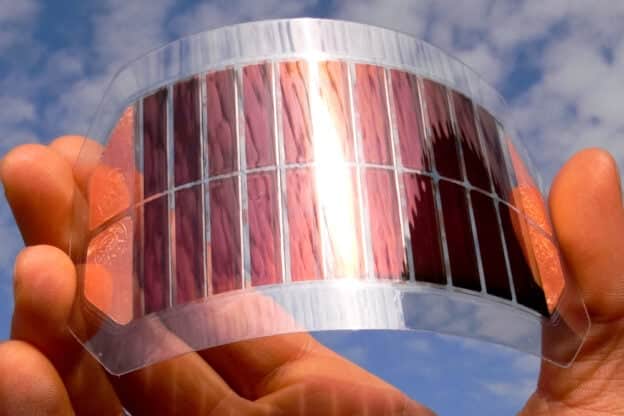
Researchers from Korea University and Dongguk University have developed a new molecular coating for organic solar cells. The coating allows for a solar cell to function as both a solar cell and a photodetector, no separate devices needed for each function.
Traditionally, these functions conflict. Solar cells require fast electron movement to generate power, on the contrary, Photodetectors need to suppress electron movement to detect faint light. Combining them in one device has been difficult until now.
The solution uses a molecule made of Benzene and Phosphonic Acid (BPA), when applied to Indium Tin Oxide (ITO) electrodes, BPA forms a self-assembled monolayer, one molecule thick. This layer chemically bonds to the surface. It aligns energy at the interface, enabling efficient electron movement and at the same time, it reduces background noise for light detection.
Tests under typical indoor lighting, shows 28.6% efficiency around 1,000 lux from LED sources at 2700K,. This is higher than conventional coatings. The coating remained stable, retaining 87% performance after 1,000 hours of light exposure. The material is cost-effective, offering nearly nine times better cost-to-performance ratio than existing options.
The dual-function device can power indoor electronics without batteries. It can operate smart sensors, wearables, and IoT devices. The BPA layer also works with flexible electronics, allowing bendable or wearable designs. The technology is scalable to larger formats without significant efficiency loss.
This approach reduces the need for separate solar and detection units. It simplifies design while maintaining performance. The technology supports battery-free indoor electronics. It could enable wider adoption of self-powered devices in homes, factories, and healthcare. The research shows that a single molecular layer can solve long-standing design challenges in indoor photovoltaics and sensor systems.