




The display platform enables isotropic expansion while preserving image quality and maintaining electrical performance.
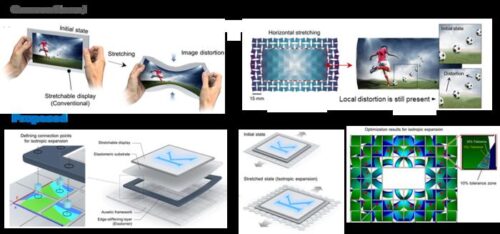
Auxetic-based stretchable display technology has been invented by researchers from Korea Advanced Institute of Science and Technology (KAIST) in collaboration with Dong-A University. It is designed for making screens expand without deforming the information presented on them. With the help of the platform, displays can expand by 15 per cent in size while keeping the original shape of the information presented on them. It is expected to help accelerate the commercialisation of next-generation high-quality stretchable displays.
Unlike conventional stretchable displays, which shrink in the opposite direction when stretched and distort images, the new platform makes use of computational analysis and selective bonding approach that bonds the required points only between the auxetic structure and the stretchable substrates. It enables the entire screen, including smaller regions such as text and images, to expand isotropically while maintaining their original shapes.
The design was validated through repeated stretching of the patterned substrates horizontally and vertically. Additionally, an LED array was incorporated into the platform to demonstrate that the device can be used as a stretchable display. Despite undergoing stretching of 15 per cent in both the horizontal and vertical direction, the display retained its electrical performance. In addition, the loss in brightness was not more than 2 per cent.
In the future, this technology could enable electronics with freely changeable shapes. These can include wearables, e-skin, medical biosensors, soft robots, and curved displays for automobiles and aircraft.
Professor Seunghyup Yoo of Korea Advanced Institute of Science and Technology said, “For stretchable displays to be used as actual information display devices, they must not only stretch well, but also preserve on-screen information accurately during stretching. This platform enables uniform expansion from small areas of the screen to the entire display, and will serve as a key foundational technology for accelerating the commercialisation of high-quality stretchable displays.”


