

Researchers from Peking University have produced a stretchable thermoelectric elastomer that converts body heat into power, paving the way for self-charging health patches, smart textiles, and implantable medical devices.
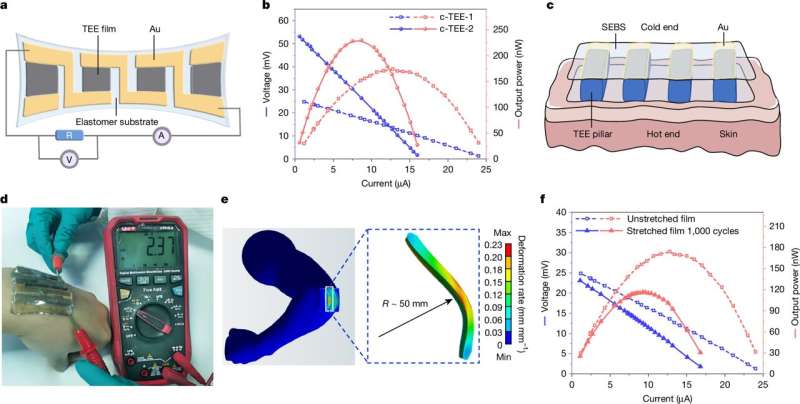
Scientists from Peking University have developed a rubber-like material that can turn body heat into electricity, opening the door to self-powered wearable devices and medical implants. Reported in Nature, the material is the first highly elastic thermoelectric elastomer that combines skin-like stretchability with efficient energy conversion. It works on the principle of thermoelectricity, where differences in temperature generate electrical current. Since human skin maintains a steady 37°C while the surrounding air is typically cooler, the material can continuously harvest this gradient to produce power. Unlike rigid thermoelectric devices, the elastomer retains its performance even when stretched up to 150% and can endure extreme strain of over 850% without breaking.
The breakthrough lies in its composition: an intrinsically elastic polymer composite doped with N-DMBI, a conductivity-enhancing agent. This design improves electrical performance while keeping the rubber-like flexibility intact. The result is a material that stays conformal to the skin, ensuring uninterrupted contact and efficient heat-to-electricity conversion. Until now, scientists struggled to develop n-type thermoelectric elastomers that could remain both highly stretchable and electrically conductive, but this advance overcomes that limitation.
For wearables, the innovation means devices could run without bulky batteries or constant recharging, transforming how health patches, fitness trackers, and smart textiles are powered. Beyond consumer gadgets, the technology could power implantable devices by drawing energy directly from the body’s natural heat, offering a sustainable, always-on solution. The research team describes it as a major step toward next-generation self-powered electronics, with the potential to integrate seamlessly into clothing, medical monitoring systems, and even surgical implants. As wearables and implantables become a trillion-dollar industry, this rubber-like energy-harvesting material could make the human body itself the most reliable power source.